
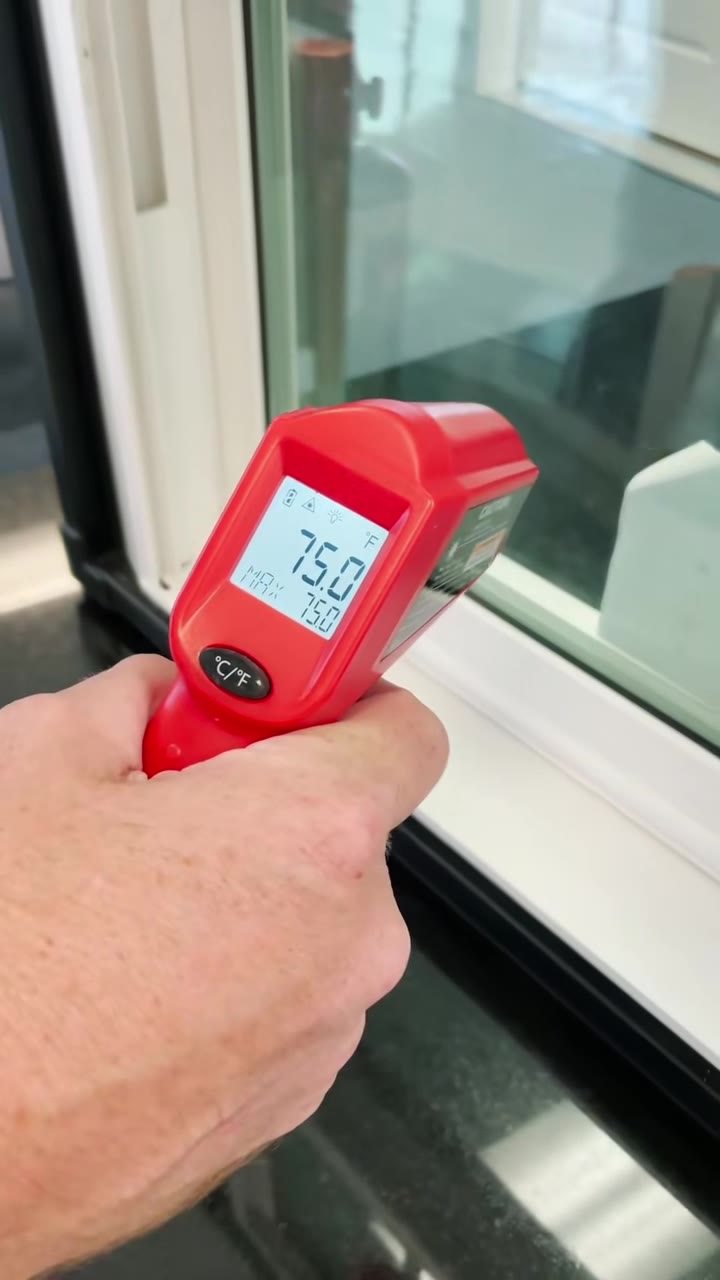
- Gulf fenestration fails through four mechanisms - wind-load deflection, sand and dust ingress, wind-driven rain with chloride corrosion, and thermal cycling - and each one needs its own written clause.
- Design pressure must be derived from the governing local wind-load provisions and the project's real exposure first; the performance class is selected afterwards and never inherited from a temperate-zone template.
- Aluminium expands about 23 x 10^-6 K^-1, so a 3 m member moves roughly 2.8 mm over a 40 C swing, which has to be absorbed by joints and shear connections rather than by rigid end-fixing.
- Solar control values, coating systems, gasket polymers and hardware grades are all measurable items, so they belong in the window schedule rather than in a supplier brochure.
1. Why Temperate-Zone Window Specifications Underperform in the Gulf
The Gulf Cooperation Council market - Saudi Arabia, the United Arab Emirates, Qatar, Kuwait, Bahrain and Oman - loads exterior fenestration with three conditions that rarely appear together in a European or North American window schedule: sustained high irradiance and elevated frame surface temperature, airborne desert dust carried on strong north-westerly shamal winds, and aggressive chloride exposure along the Arabian Gulf and Red Sea coastlines.
A system that is fully compliant with a temperate-zone specification can therefore still attract site claims within two or three seasons, not because the profile was structurally weak, but because the schedule never named the load the building would actually apply. Wind pressure was inherited from a default class, dust was treated as a housekeeping matter, and coastal salinity was addressed through a colour choice.
This guide is written for architects, main contractors and procurement teams who have to issue a window schedule that survives commissioning. It separates the four dominant failure modes - wind-load deflection, sand and dust ingress, wind-driven rain with coastal corrosion, and thermal cycling of frames and glass - and sets out the specification language that addresses each of them.
2. Wind Load: Deriving Design Pressure Before Choosing a Class
Resistance to wind load is the first clause because every other performance class is selected relative to it. The design pressure for a fenestration element is a structural input: it comes from the governing wind-load provisions applied to the site - basic wind speed, terrain or exposure category, building height and shape, external pressure coefficients, and local topography such as open coastal frontage, escarpments or channeling between towers. In the Gulf that calculation is normally carried out under the wind-load chapter of the local building code or under the ASCE 7 wind provisions, with Eurocode 1 wind actions used where a European basis is the contract reference.
The common error is not the calculation itself but the sequence. A specification copies a default declaration of performance, and the design pressure is then never confirmed against the project's own exposure. On a low-rise warehouse that omission is harmless; on an exposed high-rise it is the reason a sliding rail bows, a sash drops out of square, or a fixed light cracks in a frontal gust.
Once the design pressure is fixed, choose the test basis and class. ASTM E330 evaluates the structural performance of exterior windows, doors and curtain walls under a uniform static air pressure difference, and its report states the test pressure together with the deflection measured at the member or glass edge. EN 12210 classifies the resistance to wind load of windows and doors, with EN 12211 as the corresponding test method. Where a North American basis is required, the NAFS standard (AAMA/WDMA/CSA 101/I.S.2/A440) assigns performance classes - R, LC, CW and AW - that combine minimum air, water and structural requirements at a stated design pressure. Specify the class and the test basis together, and require the report to identify the system, the size tested and the glass build-up tested.
3. Sand and Dust Ingress: The Most Under-Specified Failure Mode
Airborne desert dust is dominated by particles in the 1-100 micron range, with a substantial fine fraction below 10 microns. It enters through any pressure difference across the envelope - wind, mechanical ventilation imbalance, stack effect - and it does not need a visible opening to travel. A gasket that seals against liquid water in a laboratory pressure test can still pass fine dust if it is not continuously compressed along its whole length.
Dust accumulates where the geometry traps it: sliding roller tracks and their rail profiles, multi-point locking keeps and gearbox cavities, drainage slots and weephole baffles, mitred corner joints, glass rebate pockets, and the gap between frame and reveal. The complaint is rarely structural. It is scored tracks, stiff handles, abraded hardware and dust lines on sills and reveals after a single dry season.
The specification response has four parts. First, require a continuous compression gasket in EPDM or silicone at every operable perimeter including head and jamb, and state the polymer family, the hardness range and a compression-set limit rather than leaving that choice to the supplier. Second, on sliding systems require a wiper or brush seal in addition to the compression seal, with a replaceable detail. Third, require hardware and drainage channels that shed rather than collect dust, with drain slots wide enough not to bridge. Fourth, make air leakage the measurable proxy: state a class under EN 12207 or a maximum leakage rate reported to ASTM E283, so the supplier has to demonstrate the seal rather than describe it. The IEC 60529 IP code is an enclosure standard and was not written for windows, but asking a supplier for dust-test evidence on a hardware cavity, in the spirit of its IP5X or IP6X grades, is a reasonable supplementary request on a desert project.
4. Wind-Driven Rain, Humidity and Coastal Corrosion
Annual rainfall in the Gulf is low, but it arrives as short, intense, wind-driven events, sometimes in the same week as a dust storm. Wind-driven rain defeats a static seal because the pressure difference across the facade pushes water past the gasket line instead of letting it run off. This is why a watertightness class quoted from a static test is not automatically adequate on an exposed elevation: AAMA 501.1 applies dynamic air pressure to the test specimen, which is closer to the driving-rain mechanism, while EN 12208 (tested to EN 1027) and ASTM E331 classify or measure static water penetration and remain the standard evidence in most export contracts. Establish which basis the class was earned on before accepting it.
Design the assembly to drain. A dependable window in a hot, humid or coastal climate is pressure-equalised and drained: a sloped sill pan, unobstructed weepholes with baffles, end dams at the jambs, a drained and back-ventilated cavity behind the cladding, and a continuous air and water barrier tied to the opening perimeter. Water that reaches the interior has almost always travelled through an undrained corner joint or around a fastener that pierced the drainage path, not through the sealed face.
Corrosion is the slower failure. Coastal and hot-humid sites combine chloride, humidity and high surface temperature, which accelerates both coating breakdown and galvanic attack between dissimilar metals. Specify exterior coatings by system rather than by colour: an architectural anodic film at 20 microns and above to ISO 7599, or a fluoropolymer coating based on a 70% PVDF resin content, is the normal Gulf baseline, with film thickness verified on the finished part. Specify stainless steel grade 316 rather than 304 for exposed hardware and fasteners in chloride-rich zones, and require galvanic isolation - isolating washers and gaskets, and correct material pairing - wherever stainless steel touches aluminium. ISO 9227 salt spray testing, and the corrosion resistance classes defined for building hardware, give a buyer a repeatable way to compare suppliers instead of trusting a finish sample. Coatings should also be assessed at cut edges and joint areas, because that is where corrosion begins.
5. Thermal Cycling: Frame Movement, Thermal Break Integrity and Glass Stress
In a Gulf climate the frame swings through a large daily and seasonal temperature range. Aluminium has a coefficient of linear thermal expansion of approximately 23 x 10^-6 K^-1, so a 3 m mullion or rail moves about 2.8 mm across a 40 C swing. That movement is small in absolute terms and entirely manageable, provided the schedule anticipates it. It becomes a defect when long members are rigidly end-fixed, when a thermal break has an inadequate shear connection, and when the glass is treated as though it does not move at all.
The thermal break is itself a cycling component. A rolled-in or crimped polyamide PA66 GF25 barrier is engineered so that its expansion behaviour closely matches the aluminium either side of it, and the connection between barrier and extrusion determines whether repeated cycling shears the joint or is absorbed elastically. Pour-and-debridge polyurethane barriers are less expensive and adequate in mild climates; in high-irradiance exposures the specification should state the barrier material, the joining method and the shear requirement explicitly.
Glass is where thermal cycling causes the most expensive failures. A glazing panel absorbs solar energy in its body and coating and dissipates heat from its edges into the frame; dark tints, high-performance coatings and interior blinds that trap heat all raise the edge-to-centre temperature differential, which is the direct driver of thermal stress fracture. EN 12150-1 covers thermally toughened soda lime silicate safety glass, and heat soaking to EN 14179-1 is intended to reduce the residual risk of spontaneous fracture associated with nickel sulphide inclusions - a step worth specifying where deep tints, solar-control coatings or high-absorption combinations are used and replacement access is difficult. Laminated glass to EN 14449 retains fragments where safety, security or post-break integrity matters. Because glazing performance has to be declared rather than assumed, suppliers should report solar and luminous values determined in accordance with EN 410 or ISO 9050, and U-values calculated under EN ISO 10077-1 together with EN ISO 10077-2.
| Cycling Load | Mechanism | Specification Response |
|---|---|---|
| Frame thermal expansion | Aluminium moves about 23 x 10^-6 K^-1; a 3 m member travels roughly 2.8 mm over a 40 C swing | Provide allowance joints at long mullion, transom and corner connections; avoid rigid end-fixing of long members |
| Thermal break shear connection | Repeated differential movement across the polyamide barrier loads the barrier-to-extrusion joint | State the barrier material, the joining method and the shear requirement instead of leaving the barrier type open |
| Edge-to-centre glass stress | Absorbing tinted or coated glass heats faster than the shaded glass edge | Specify heat-strengthened or toughened glazing, heat-soaked where tint and coating raise absorption; avoid interior blinds in contact with the glass |
| Gasket compression set | Sustained heat reduces rebound force and therefore sealing pressure on the operable perimeter | Specify the polymer family, hardness range and a compression-set limit, and verify it on a cycled sample |
| Coating and sealant ageing | UV radiation combined with high surface temperature embrittles flexible materials | Use fluoropolymer or anodic coatings on metal, and UV-stable silicone or EPDM sealants with documented UV performance |
6. Solar Control: Solar Factor, Daylight and the Comfort Brief
Solar control is the single largest determinant of interior comfort and cooling load in the Gulf, and it is also the clause most often written as a product name instead of a number. Specify the numbers. The solar and luminous characteristics of glazing are determined under EN 410 or ISO 9050, which define solar direct transmittance, the solar factor (also reported as the solar heat gain coefficient), light transmittance and reflectance. Those values, not the coating's marketing description, drive the energy model.
Set the target by orientation. West and west-of-south elevations carry the highest cooling penalty and should normally receive the lowest solar factor, while north elevations can run a higher light transmittance to protect daylight autonomy. Resolve the trade-off consciously: lowering the solar factor without limit reduces visible light and pushes occupants towards blinds and supplementary lighting, which recovers part of the load that was just removed. External shading - overhangs, deep reveals, fixed louvres or screens - is more effective than glazing alone because it intercepts radiation before it reaches the glass, and it should be evaluated first.
U-value matters less in the Gulf than in a heating climate, but it does not disappear: it still governs night-time heat flow, condensation risk in a conditioned interior during humid periods, and compliance with the envelope targets in local energy codes. Report it transparently as calculated under EN ISO 10077-1 and EN ISO 10077-2 for the whole window, and state whether the figure includes the frame, the spacer and the installation junction.
7. Specification, Sample Approval and Pre-Shipment Verification
A Gulf window schedule should be written so that a supplier can only answer with the system that actually meets the requirement. Put the following into the document rather than into a conversation: design wind pressure with its derivation basis and a deflection limit expressed as a fraction of the clear span; air leakage class and test basis; watertightness class and test basis, with dynamic testing required where the elevation demands it; solar control values for the glazing build-up; frame coating system with a verified dry film thickness and a corrosion class; gasket polymer, hardness range and compression-set limit; hardware material grade and corrosion resistance class; and the complete glazing specification including heat-soak requirements where they apply.
Require the supplier's evidence to be system-specific. A test report is valid for the system, size and glazing measured in that test, so transferring a certificate from a small casement to a large sliding element, or from clear glass to a deep tint, invalidates it. Ask for the drawing and the report of the tested configuration, and for first-article approval of one unit from the production line before the batch is released. For Gulf projects with long ocean transit, agree a pre-shipment inspection protocol: dimensions checked against the approved window schedule, glass build-up verification, gasket and hardware checks, coating thickness readings, a water test on a sample unit where practical, and photographic records with crate markings keyed to the project's opening marks.
Protect the installation, not only the product. ASTM E2112 provides practice for installing exterior windows, doors and skylights, and its principles - continuity of the air and water barrier, correct flashing sequence, and drainage to the exterior - apply unchanged in the Gulf. Site-applied sealants and flashing tapes must be selected for UV exposure and high surface temperature, because materials that perform indefinitely in a cool climate can embrittle within a few seasons here.
8. Practical Cross-Check Before the Schedule Is Issued
Use the list below as a final check on the window schedule before it is released for tender.
- Design wind pressure stated, derived from the governing local wind-load provisions or ASCE 7 for the actual exposure, with a deflection limit defined as a fraction of the clear span.
- Structural, air and water evidence named together, with dynamic water penetration required on exposed coastal elevations.
- Sand ingress controlled by continuous compression gaskets with a specified polymer and compression-set limit on every operable perimeter, plus wiper or brush seals on sliding tracks.
- Drainage verifiable on the shop drawing: sloped sill, baffled weepholes, jamb end dams and a drained, back-ventilated cavity.
- Corrosion resistance by system: fluoropolymer or 20 micron-plus anodic exterior coating, grade 316 stainless hardware in chloride zones, and galvanic isolation at every dissimilar-metal junction.
- Thermal cycling addressed: movement allowance over the design temperature range, a stated thermal break material and joining method, and heat-soaked toughened glazing where dark tints or solar-control coatings raise edge stress.
- Solar control values set per orientation and determined under EN 410 or ISO 9050.
- Verification agreed: system-specific test reports, first-article approval and a pre-shipment inspection protocol.
Frequently Asked Questions
Do Gulf projects need different window specifications from European ones?
Yes. The governing loads differ. Design wind pressure has to be derived from the project's own exposure, sand and dust ingress needs continuous compression sealing on every operable perimeter, and chloride exposure in coastal zones calls for fluoropolymer or heavy anodised coatings combined with grade 316 stainless hardware and galvanic isolation.
Which test basis should be specified for wind-driven rain in the Gulf?
It depends on the reference framework in the contract. EN 12208 with the EN 1027 test method, and ASTM E331, both measure static water penetration, while AAMA 501.1 applies dynamic air pressure and is closer to the driving-rain mechanism. On exposed coastal elevations it is reasonable to require dynamic water penetration testing and to state that basis explicitly in the schedule.
Can toughened glass still break from thermal stress in a hot climate?
Thermally toughened glass is far more tolerant of thermal stress than annealed glass, but stress still rises with solar absorption and with edge-to-centre temperature differentials caused by dark tints, solar-control coatings or interior blinds. Heat soaking to EN 14179-1 reduces the separate risk of spontaneous fracture from nickel sulphide inclusions; it does not remove the need for thermal design.
Explore OPPGATE Aluminum Windows
Thermal break aluminum sliding, casement, tilt-and-turn and panoramic window systems for global residential and commercial projects.
View All Aluminum Windows Models
Planning a Commercial or Villa Project?
Send your window schedules or architectural CAD drawings to the OPPGATE engineering team for a prompt, certified quotation and structural review.
Request an Engineered Quotation