
- Aluminium is almost always the anode in a fenestration joint, so the metal that corrodes is the one the client paid to protect.
- A small anode against a large cathode concentrates the attack into a few square millimetres: pitting under a fixing head can perforate a profile wall long before any coating shows a defect.
- ISO 9223 classifies the corrosivity of the site, not the durability of the product; the same window assembly can be adequate in C3 and inadequate in C5 or CX.
- Salt spray hours are a screening result, not a service life: no accelerated test reproduces a sheltered lap joint that stays wet between evaporation cycles.
- Corrosion control on this scale is a drawing and site-management problem, not a paint problem.
1. A Corrosion Failure That Begins at a Fastener, Not at the Coating
An aluminium window is not a material. It is an assembly. Inside one opening there is usually an aluminium extrusion, a polyamide thermal barrier, a galvanised steel or uPVC reinforcement, stainless or zinc-plated screws, EPDM gaskets, a powder-coated or anodised finish, a double-glazed unit with an aluminium or stainless spacer, and a host structure of concrete, masonry, structural steel or timber. Every point where two of those materials touch, with water present, is an electrochemical cell waiting for an electrolyte. On a coastal elevation the electrolyte arrives free of charge, several times a day.
When a facade shows corrosion inside the first five years, the first report almost always names the finish. The paint has chalked, the anodising has stained, the powder coat has failed. On closer inspection a different pattern emerges: the coating is intact over most of the profile, but there is pitting in a ring around each fixing, white corrosion product bleeding out of a mitre, or a brown streak running down a light-coloured wall from a bracket nobody specified. That is not a coating defect. It is bimetallic corrosion, and it is localised around the joints where the design put two different metals into contact.
The reason this failure mode deserves its own place in a specification rather than a line in a maintenance manual is that it is unrecoverable. Coating damage can be touched up. A galvanic pit has removed metal from the section, inside a lap joint, behind a gasket, or under a sill where no one can reach it without dismantling the opening. By the time the white salts appear on the face, the wall of the profile may already be thin enough to matter structurally, and the fix is replacement, not repair.
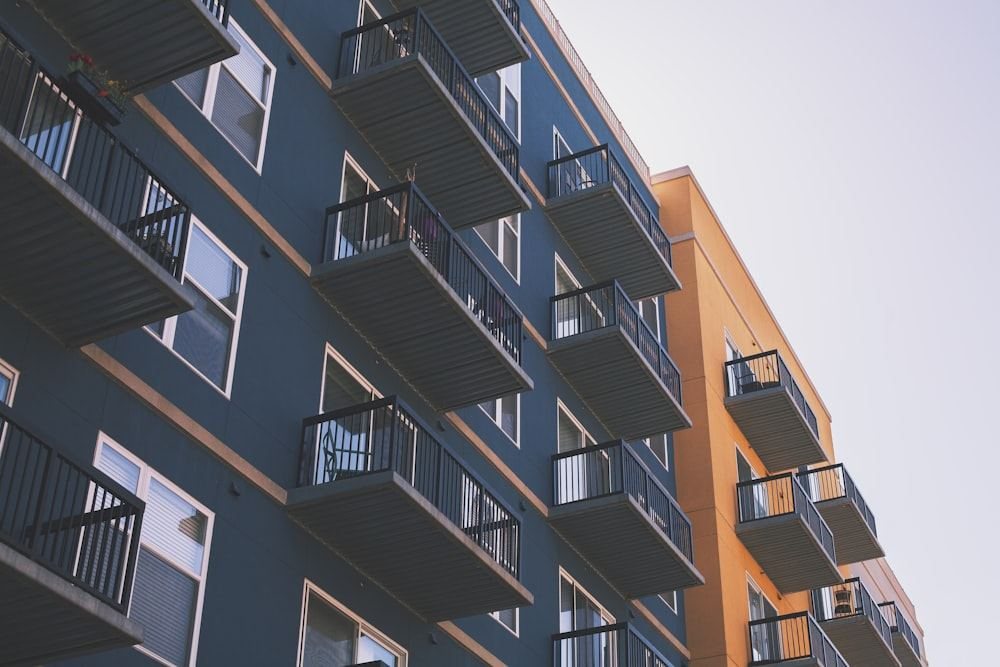
It is also entirely predictable. The metals in a window schedule are chosen by a designer months before anyone on site picks up a drill. The corrosion behaviour of those choices is settled engineering, not weather. The photograph above shows the situation in its most common form: residential balconies where aluminium-framed doors meet steel balustrades, concrete soffits and rendered walls, all of them wetted by the same rain and dried by the same sun.
2. The Mechanism: Anode, Cathode, Electrolyte and the Area Ratio That Decides the Damage
Galvanic corrosion needs four things at once: two metals with different electrochemical potentials, a metallic path between them, an electrolyte bridging the gap, and an oxidant, normally dissolved oxygen. Remove any one and the cell stops. This is why the subject rewards detailing rather than material purism. It is rarely possible to build a window with only one metal in it, but it is entirely possible to break the circuit or keep the joint dry.
Aluminium sits low in the galvanic series, which means that in almost every practical couple found on a building it becomes the anode and dissolves. Its natural protection is a passive oxide film a few nanometres thick that reforms within milliseconds in air. That film is the whole reason aluminium survives outdoors. But it cannot reform where oxygen cannot reach, and a lapped joint, a screw thread, a gasket groove or the underside of a sill is exactly where oxygen cannot reach. The passive film is consumed in the crevice, the potential there drops, and the surrounding exposed aluminium becomes the cathode for the crevice. Attack accelerates in the least visible place in the assembly.
The variable that decides how bad the outcome is, is the ratio of cathode area to anode area. When a small anode is coupled to a large cathode, all of the dissolution current generated over a large cathodic surface is forced out through a small anodic area. The result is deep, fast pitting rather than the slow general wastage that a large anode would tolerate. A stainless steel screw driven into an aluminium profile is the textbook geometry for this: the stainless fastener is a comparatively large, efficiently cathodic surface, and the aluminium immediately around it and inside the tapped hole is a very small anode. The corrosion rate at that ring can be orders of magnitude higher than the rate on a bare aluminium face a hundred millimetres away.
The electrolyte controls the rate as well. Pure condensate is a poor conductor and the cell is weak. Chloride changes that: it raises conductivity, it attacks the passive film directly, and it keeps the pit active by acidifying the local chemistry. Coastal aerosol, de-icing salt, mortar leachate and acidic cleaning residues are all chloride or acid sources that find their way into the same joints. This produces a counter-intuitive result that repeatedly confuses site teams. A poorly sealed joint that drains freely can outlast a carefully sealed joint that holds a teaspoon of water, because the second one keeps a concentrated electrolyte in permanent contact with the couple.
3. Where the Junctions Are: An Interface Register for a Typical Opening
Corrosion control fails when it is treated as a property of the window rather than a property of the interfaces around it. The useful working document is an interface register: a list of every point in the assembly and its immediate surroundings where two metals, or a metal and a chloride source, meet. On a typical commercial opening the register is longer than most schedules assume.
The following list covers the junctions that account for most field failures. It is worth checking each one against the actual project, because the responsibility for half of them sits with trades that never see the window specification.
- Fixings into the profile. Hinges, keeps, restrictors and handle bases are usually fixed with self-tapping or thread-forming screws. Plain zinc-plated steel is common because it is cheap and it looks acceptable on a bench. In chloride exposure the zinc coating is anodic to the aluminium and is consumed first; once bare steel is exposed, the steel becomes cathodic and the aluminium around the hole becomes the anode.
- Balustrades and glass barriers. Stainless base plates, spigots and clamps are frequently fixed through aluminium sills, copings or terrace door thresholds, with the fixing holes drilled on site after the coating is applied.
- Structural connections. Galvanised steel brackets, cast-in channels, anchor bolts and steel angle sub-frames connect the aluminium frame to the building. The junction is often hidden behind a plasterboard reveal or a stone soffit.
- Reinforcement inside uPVC. Galvanised steel cores are normal and acceptable inside a sealed profile, but they become a corrosion source when cut ends are left open, when the reinforcement is exposed by a fixing, or when water reaches the cavity through an unsealed screw hole.
- Copper-bearing materials. Copper rainwater goods, lead flashings, bronze door furniture and copper-alloy hardware are all strongly cathodic to aluminium. Water running from copper onto aluminium carries the couple with it, which is why the damage often appears downstream of the actual contact.
- Preservative-treated timber. Copper-based preservative systems in sills, packers and sub-frames put a copper source directly against the frame. The same applies to timber that has been treated and then left wet.
- Mortar and concrete. Fresh mortar is alkaline and attacks the aluminium oxide film chemically before any galvanic action starts; embedded fixings then add the electrochemical component.
- Post-handover additions. Satellite brackets, signage, security grilles, awnings, planter boxes and cleaning-access anchors are commonly fixed to the window frame or the reveal with whatever fastener is in the van.
The last item on that list is the one that most often defeats an otherwise sound specification, and it is a management problem rather than an engineering one: the window leaves the factory with a correct fixing regime, and the building is handed over with a dozen new holes in it.
4. Reading the Evidence: What Contact Corrosion Looks Like Before It Becomes a Claim
Bimetallic attack has a recognisable signature, and learning to read it changes the commercial outcome. A claim that names the wrong mechanism usually produces the wrong remedy, an argument about paint warranties, and a repair that repeats the original mistake.
The first clue is the corrosion product. Aluminium corrodes to a voluminous white or pale grey hydroxide that has no rust colour at all. On a light render or a white powder coat it reads at a distance as efflorescence, dust or dried sealant. It usually appears as a trail running from a joint or a fixing downward, following the path the water takes, and it often reappears within weeks of being cleaned off. A brown or orange stain, by contrast, means iron is involved: either a steel component is corroding on its own, or ferrous particles have been embedded in the finish and are now staining the facade as they rust.
The second clue is location. Coating defects are generally distributed: chalking over a whole elevation, a mottled patch where the pretreatment failed, blistering in a broad area. Galvanic attack is localised and follows metal. Look for pitting in a ring around screw heads, along mitre joints where a steel corner cleat sits inside the profile, at site-drilled holes, and at cut ends where the coating does not continue. Look for a straight line of blisters where a steel angle has been fixed behind the frame, and for crevice attack under gaskets and in glass rebates where chloride concentrates as water evaporates.
The third clue is what happens when you take it apart. A fastener removed from a suspect location will normally show a clean shank in the middle of the profile thickness and a corroded or bright-ringed area where it passed through the aluminium wall, with a matching ring of white product and a pit in the profile. That evidence is worth more than any number of photographs taken from ground level, and it should be captured before anything is cleaned or replaced.
A practical inspection protocol is short enough to write into a handover document. Select one opening per elevation, ideally the most exposed. Remove one fastener from a hardware fixing and one from a threshold or balustrade connection. Photograph the fastener, the hole and the surrounding finish under raking light. Record whether an isolating washer was present, whether the hole had been treated after drilling, and whether the cavity drained. Repeat at intervals that match the site corrosivity rather than the defects liability period, because the most damaging period for a galvanic joint is often the second and third year, once initial sealant movement and building settlement have opened a path for water.
5. The Standards That Apply, and the Comfort They Do Not Provide
There is no product standard that certifies an aluminium window as immune to galvanic corrosion, and procurement documents get into trouble when they pretend otherwise. What the standards do provide is a way to describe the site, a way to rank material couples, and an accelerated screening test whose limits need to be understood.
ISO 9223 classifies the corrosivity of an atmosphere, from C1 (very low, heated interiors) through C2, C3, C4 and C5 to CX (extreme, for example offshore or heavily industrial coastal locations). The classification is built from time of wetness, sulphur dioxide and chloride deposition, so it describes the environment the building sits in, not the quality of the product installed in it. This is the single most useful input to a fixing schedule, and it is also the item most often missing from a tender package. Two identical windows can be a correct specification on a C3 inland site and an under-specified one on a C5 marine site, and neither the product datasheet nor the CE marking will tell you which one you have.
EN 1999-1-1, the European code for aluminium structures, treats durability as a design consideration and requires the designer to address contact between aluminium and other materials. It is a structural code, however: it tells you that the issue exists and must be dealt with, not which washer to use.
ASTM G82 provides a galvanic series for ranking metals and alloys in a given environment. It is a comparison tool. A favourable position in the series reduces the driving potential of a couple; it does not eliminate the couple, and it says nothing about area ratio, crevice geometry or the chloride concentration inside a specific joint.
ISO 9227 neutral salt spray and the equivalent ASTM B117 practice are accelerated laboratory tests. They are useful for comparing one finish system against another under identical conditions, and they are widely quoted in marketing. They do not predict service life. A neutral salt spray test floods a flat specimen with a continuous electrolyte, while the real failure happens in a sheltered lap joint that is wet for a few hours at a time and then dries, concentrating chloride as it does so. There is no reliable conversion from salt spray hours to years in service, and a specification that asks for a number of hours without saying what the test is for has bought a data point rather than a defence.
EN 14351-1, the harmonised product standard for windows and doors, covers performance characteristics such as air permeability, watertightness, wind resistance and thermal transmittance. It does not establish a corrosion durability class for the fixings and interfaces inside the assembly. And a supplier quality certificate under ISO 9001 confirms that a process is controlled; it is not evidence that any particular joint on your project is protected.
The practical conclusion is that the defence has to be written, not purchased. Because no single standard certifies the joint, the joint has to be specified by material, by isolation and by drainage, and then verified by inspection at a defined hold point.
6. Designing the Defence: Material Choice, Isolation, Drainage and Detailing
A durable assembly usually uses four measures together, because each one alone has a failure path. Material selection reduces the driving potential. Isolation breaks the metallic path. Sealing and drainage control the electrolyte. Detailing decides whether any of it can be inspected and maintained.
Material selection. In chloride-bearing environments the default for exposed and semi-exposed fixings should be stainless steel of a grade appropriate to the exposure, with the more highly alloyed austenitic grades used where chloride is persistent. Inland, in low-corrosivity categories, zinc-plated fasteners can be acceptable where they are protected from standing water, but they should not be the default on a coastal facade. Copper alloys, lead, and copper-based preserved timber should not be in contact with aluminium at all, and where a copper component is unavoidable it must be downstream of the aluminium in the drainage path, not above it.
Isolation. Nylon, polyamide or EPDM washers and bushes under fastener heads, isolating tape behind a bracket, and coated washers are all standard measures. The important point is that isolation only works when it is complete. A washer under the head does nothing if the thread is in direct metallic contact with the tapped aluminium, which is why the detail usually needs an isolating bush or a fully sleeved fastener, or a sealant-filled interface that excludes water from the thread. Partial isolation is worse than none in one respect: it creates a small, well-defined anode at the point where contact remains.
Sealing. A neutral-cure silicone or a hybrid polymer sealant excludes electrolyte from the joint and keeps oxygen out of the crevice, which suppresses both galvanic and crevice attack. Acid-cure silicone should be avoided in contact with aluminium because the acetic acid released during cure attacks the oxide film. Sealant is a moisture barrier, not a structural connection, and it should never be used to compensate for a joint that cannot drain.
Drainage and ventilation. Every horizontal profile and every threshold needs a path for water to leave and air to enter. Drain slots, weep holes and a slight fall are more effective than any coating, because they remove the electrolyte rather than resisting it. Two failures recur: a sill that is sealed on all four sides and becomes a tray, and a cavity that is closed with expanding foam that holds water against a steel bracket. Both convert a C4 site into something closer to continuous immersion at one detail.
Detailing for the coating's limits. Powder coating and anodising protect the surfaces they cover. They do not protect cut ends, drilled holes, the inside of a tapped hole, or the face behind a gasket. Those areas must be treated during fabrication, and site drilling must be followed by a compatible repair coating before the fastener goes in. It is also worth placing dissimilar-metal junctions where they can be seen: a bracket on the inside face of a reveal can be inspected; the same bracket buried under a stone soffit cannot, and its failure will only be discovered when the stone stains.
7. Site Practice: The Habits That Undo a Correct Specification
Most of the damage found on completed buildings was not designed in. It was introduced between the delivery note and practical completion, by trades working to a programme rather than a durability strategy. Five habits account for a large share of it, and all five are controllable through a short method statement and one inspection.
- Drilling and cutting after coating. A hole drilled through a powder-coated profile exposes bare aluminium and, more importantly, leaves an untreated annulus inside the wall where water will sit against the fastener. The same applies to cut ends of reinforcement and to mitres trimmed on site. Every site-made opening should be treated before assembly, and the treatment should be on the approved method statement rather than left to habit.
- Acid-based masonry cleaners. Hydrochloric acid-based cleaners used to remove mortar smear will attack aluminium, and the residue runs into the same joints that hold the fixings. Where such cleaners are used on the facade, the windows must be protected, the surfaces pre-wetted, and everything flushed with clean water afterwards. A neutral or inhibited cleaner is the safer default on an aluminium elevation.
- Grinding and cutting steel nearby. Sparks from a cutting disc embed ferrous particles in the coating, which then rust and stain. The stain is often reported as corrosion of the window, and while the mechanism is different the visual result on a pale facade is the same. Cutting and grinding should be screened, and the elevation cleaned after the work, not before.
- Storage and protection. Frames stored flat on the ground, on steel stillages, or with water trapped in the profile begin the process before installation. Protective film left on through weeks of sun leaves adhesive residue that is difficult to remove and is frequently mistaken for finish failure. Storage off the ground, under cover, with drainage clear, is a delivery instruction, not an aspiration.
- Substitute fasteners. The most common single cause of a new corrosion site is a fixing installed because it was the right length rather than the right material: a plain steel screw used to hold a temporary alignment, a galvanised bolt used because the stainless box had run out. Fastener control on site means one sealed container, issued against the schedule, and a rule that the container does not get refilled from the van.
These points belong in the site induction and in the facade contractor's method statement, not only in the window supplier's installation manual. The party who installs the balustrade, the stone and the services is usually the party who creates the last junction, and that party is rarely given the corrosion requirements at all.
8. Writing It Into the Specification: Clause Wording and Hold Points
Because no harmonised standard certifies the joint, the requirement has to appear as contract language. The clauses below are written to be adopted directly into a fenestration specification or a facade package, and they are deliberately testable, so that an inspector can accept or reject against them without an argument about interpretation.
- All metallic components in contact with aluminium shall be of a material compatible with the corrosivity category of the site as classified in accordance with ISO 9223, and the category shall be stated in the specification.
- Exposed and semi-exposed fasteners shall be stainless steel of a grade suitable for the chloride exposure of the site. Plain carbon steel and zinc-plated steel fasteners will not be accepted at balustrade, threshold and bracket connections.
- Every dissimilar-metal junction shall be separated by a continuous electrically insulating barrier. Isolating washers alone are not acceptable where the fastener thread is in direct contact with the aluminium; a sleeved fastener or a sealed interface shall be used.
- No copper, copper alloy, lead, or timber treated with a copper-based preservative shall be placed in contact with aluminium, or positioned above aluminium in the drainage path.
- Cut edges, mitres and all site-drilled holes shall receive a compatible repair coating before assembly. The repair product and its application method shall be included in the approved method statement.
- Every horizontal profile and threshold shall drain. The drainage path, including weep holes and falls, shall be demonstrated at the mock-up stage and shall remain clear after the facade trades have finished.
- Sealants in contact with aluminium shall be neutral-cure or hybrid polymer. Acid-cure silicone is not permitted at aluminium interfaces.
- Acid-based masonry cleaning shall not be used on elevations containing aluminium fenestration unless a protection and flushing method is approved in advance.
Three hold points make those clauses enforceable. The first is at mock-up: one typical opening, fully assembled with its balustrade or bracket connection, inspected for isolation continuity, sealant and drainage before production is released. The second is at delivery: fastener certification checked against the schedule, and one container opened to confirm the material and grade. The third is before the reveals and soffits are closed: a walk-through of every elevation to confirm that no post-installation fixing has been made into a frame without treatment, and that drainage paths are still open.
After handover, the maintenance regime should match the exposure rather than the defects period. Washing with a pH-neutral detergent, clearing debris from sills and drainage slots, and repairing coating damage promptly will extend the life of any assembly, but none of it compensates for a joint that was designed with a small anode against a large cathode. The comparison that settles the argument in a value-engineering meeting is straightforward: an isolating bush and a stainless fastener cost a small fraction of one percent of the opening, while the labour of dismantling a glazed balcony door to replace a corroded transom, and the scaffold that goes with it, is measured in days. Bimetallic corrosion is one of the few durability risks on a facade that can be removed almost entirely at the drawing stage, provided someone is asked to look for it.
Explore OPPGATE Aluminum Windows
Thermal break aluminum sliding, casement, tilt-and-turn and panoramic window systems for global residential and commercial projects.
View All Aluminum Windows Models
Planning a Commercial or Villa Project?
Send your window schedules or architectural CAD drawings to the OPPGATE engineering team for a prompt, certified quotation and structural review.
Request an Engineered Quotation