
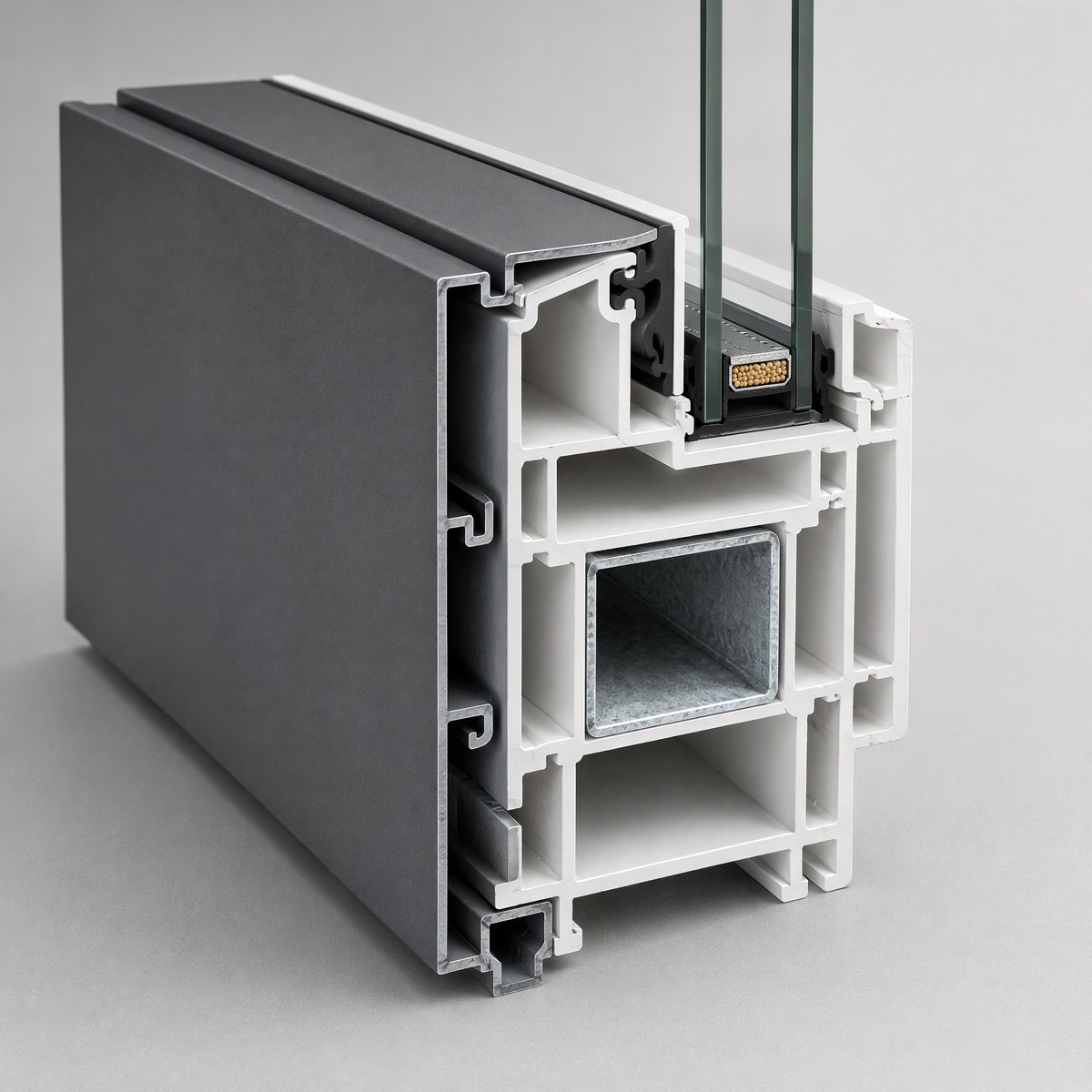
- Co-extruded, mechanically clad and cover-capped frames are three different products with the same marketing vocabulary; what separates them is whether the aluminium is bonded along its full length or merely clipped over the core.
- Rigid PVC-U moves roughly 0.06 to 0.08 mm per metre per kelvin against about 0.023 mm for aluminium, so over a 3 m section and a 40 K swing the core travels around 8 mm while the skin travels under 3 mm - the interface has to absorb that difference every day.
- Aluminium carries most of the stiffness in the section but only if the connection transfers shear; sum the two materials' section properties without a verified shear connection and the wind-load check is overstated by a wide margin.
- A dark aluminium skin raises the temperature of the PVC core behind it, so the colour that created the demand for the product also moves the thermal problem inward rather than removing it.
- The cavity between skin and core is either drained and pressure-equalised or it is a trap; trapped water plus a freeze cycle is how a clad profile starts to come apart months after installation.
- An aluminium skin that wraps to the interior face is a cold bridge regardless of the core's chamber count, and the condensation will appear at the reveal where nobody specified a detail.
- Test evidence is specimen-specific: a profile class to EN 12608-1 says nothing about a window's performance, and a European classification does not carry across to a NAFS performance class in North America.
1. Two Materials in One Section: What Co-Extrusion and Cladding Actually Mean
The phrase aluminium-plastic co-extruded window is a literal translation, and it hides three different constructions that behave differently in service and differently in a quotation. The first is genuine co-extrusion, where the aluminium and the PVC-U are formed and bonded together along the full length of the profile so that the joint is a continuous bond line. The second is mechanical cladding, where an extruded aluminium shell is clipped or screwed over a finished uPVC profile, leaving a cavity and a set of fixing points between the two. The third is a cover cap, where aluminium appears only as a thin decorative face on one side of the frame and carries nothing at all.
Buyers confuse the three because the same photograph sells all of them. The distinction that matters is what the connection between the materials is asked to do. In a bonded section the joint must survive shear cycling for the life of the building. In a mechanically clad section the joint is allowed to move, and the design question moves to the cavity behind the skin: how water leaves it, how air pressure equalises across it, and how the fasteners behave in a wet, concealed space. In a cover cap neither question arises, because nothing is being asked of the aluminium except to look right, and the frame's behaviour is entirely that of the uPVC profile underneath.
Terminology then becomes a procurement problem rather than a linguistic one. A specification that asks only for co-extruded aluminium-plastic profiles will be answered by suppliers offering roll-formed aluminium covers over commodity uPVC, because that phrase does not exclude them. The buyer-side terms that actually map onto the product are hybrid vinyl-aluminium or aluminium-clad vinyl in North America, and PVC-aluminium or aluminium-clad uPVC in Europe. A specification written with those terms, and with an explicit statement of whether the aluminium is extruded or roll-formed and whether it is bonded or clipped, gets a comparable answer from every supplier on the list.
2. The Dimensional Argument: 0.07 Against 0.023
The two materials move at very different rates, and that difference is the arithmetic the whole interface has to survive. Rigid PVC-U expands at roughly 0.06 to 0.08 mm per metre per kelvin, commonly taken as 0.07 for design. Aluminium expands at about 0.023 mm per metre per kelvin, and steel reinforcement inside the PVC chamber at about 0.012. Over an ordinary service temperature swing the core and the skin therefore travel very different distances, and they travel them every day.
| Section length | PVC-U core at 0.07 mm/m·K | Aluminium skin at 0.023 mm/m·K | Difference the joint absorbs |
|---|---|---|---|
| 1 m, 40 K swing | about 2.8 mm | about 0.9 mm | about 1.9 mm |
| 3 m, 40 K swing | about 8.4 mm | about 2.8 mm | about 5.6 mm |
| 6 m, 40 K swing | about 16.8 mm | about 5.5 mm | about 11.3 mm |
There are only two honest ways to accommodate that. The joint is bonded by an adhesive or a co-extruded seam that is designed to carry the resulting shear, or the two materials are left free to slide relative to one another and the design provides for the movement at the ends, at the corners and at every fixing. What fails is the middle case: a joint that is nominally bonded but not designed for shear, or a clad profile fixed rigidly at both ends of a long run with no allowance between them. The symptom appears late. A bonded seam that has been working in shear for two years releases at a corner first, because the corner is where the two directions of movement meet, and a clipped skin that had no allowance buckles between two fixings on the sunny elevation.
One further consequence is worth putting in the schedule. Because the core moves further than the skin, the expansion allowance is set by the PVC and not by the aluminium. A long run of hybrid frames needs the same jamb clearance and slip provision that a pure uPVC run needs, and a detail copied across from an aluminium window of the same width will be short of it. The frame material in the drawing title block is not the material that governs the movement.
3. Colour, Solar Gain and the Reason the Product Exists at All
Demand for hybrid sections comes largely from one aesthetic direction: modern residential elevations want dark, matte, narrow frames, and dark grey or black has become the default in new-build housing across North America and northern Europe. An unclad dark uPVC profile is a difficult product in that role. Rigid PVC-U is a thermoplastic whose Vicat softening range sits roughly between 70 and 80 degrees Celsius; a dark surface in strong summer sun absorbs enough radiation to run far above ambient air temperature, and the combination of a dark surface, a still day and a west or south-west exposure is exactly the condition that produces the bowed sash and the dropped corner that the market has learned to associate with black plastic frames.
An aluminium skin solves the visible half of that problem. It tolerates a higher surface temperature without losing shape, it holds a dark colour without the same risk of distortion, and it takes impact far better than PVC-U does at low temperature, which matters in hail and in cold-climate handling. That is a real engineering benefit and it is the reason the category continues to grow.
What the skin does not do is make the section cooler. It does the opposite. A dark aluminium surface absorbs solar radiation efficiently and conducts heat readily, so the PVC core behind it runs hotter than the same core would behind a light-coloured, unclad surface. The colour decision therefore relocates the temperature problem inward instead of removing it. That has three practical consequences: the core's own heat stabilisation and its reinforcement arrangement have to be right for a dark-exposure service temperature rather than a light one; any component in the cavity behind the skin, including gaskets and fasteners, has to tolerate that temperature; and on very dark colours in genuinely hot exposures, a hybrid section is the wrong answer rather than a better one, because the mechanism that would keep it stable has been removed and only the appearance has been retained.
4. Who Is Structural? Section Properties and the Shear-Transfer Trap
Wind load on a hybrid window arrives at the section and has to leave through the fixings, and the question that decides whether the section is adequate is not which material is stronger but which material is connected. Aluminium has an elastic modulus around 70 GPa; rigid PVC-U is roughly 2.5 to 3 GPa; the galvanised steel reinforcement that usually sits inside the PVC chamber is about 210 GPa. Those figures mean that in a genuinely composite section the aluminium would carry most of the bending, and in a non-composite section it would carry almost none of it, because it is not connected to anything that is bending.
The common error is to add the two contributions together without establishing which case applies. A moment of inertia computed by summing the aluminium skin and the PVC core assumes full shear transfer between them, and full shear transfer is a property of the joint, not of the drawing. Unless the bond line has been designed and verified for that shear, the correct assumption is the conservative one: the uPVC profile plus its steel reinforcement resists the wind load, and the aluminium skin is treated as a weathering and appearance layer whose only structural duty is to stay attached.
That conservative reading has a useful consequence for specification, because it points at the components that actually matter. It makes the reinforcement gauge, its corrosion protection and its continuity across the corners the structural variables, and it demotes the aluminium skin thickness to a durability and appearance variable - still important, because a thin roll-formed cover dents and loses its shadow line, but not the thing that keeps the window in the opening. It also explains why a heavy, well-reinforced uPVC core behind a modest aluminium skin can outperform a thicker skin over an unreinforced core, which is the opposite of what the elevation suggests.
The load side of the calculation is unchanged by any of this. The design pressure still comes from the applicable loading code, EN 1991-1-4 in Europe or ASCE 7 in North America, and it is still a project action rather than a product property. A classification to EN 12210, or a laboratory result to ASTM E330, describes what a specimen did in a stated configuration at a stated pressure; it does not tell anyone what the section can carry in a different size, with different reinforcement, in a different fixing condition. The two numbers are related and are not interchangeable, and the gap between them is the structural check.
5. The Bond Line and the Cavity Behind It
Where the aluminium is bonded to the core, the bond line is a structural element that nobody inspects. Co-extruded seams and structural adhesives both rely on surface preparation that is invisible after the profile leaves the die, and both degrade from the edges inward when water reaches the interface. The failure is quiet and progressive: a seam that has lost adhesion over a few centimetres still looks continuous, and the first evidence is usually a rattle in wind, a shadow line that has opened at a corner, or water appearing on the inside of a frame that has no visible defect.
Where the aluminium is mechanically clad, the joint is designed to move, and the design problem moves into the cavity. That cavity is a small, concealed, intermittently wet space bounded by two materials with different surface temperatures. It has to do three things: let water that enters drain out rather than sit; let air pressure equalise across it so that wind-driven rain is not pushed through to the interior by a pressure difference the cavity itself creates; and keep its fasteners from becoming the corrosion site. A cavity with no outlet at the bottom fails all three at once. Water collects at the lowest point, a freeze cycle expands it, and the skin is jacked away from the core by a few tenths of a millimetre each season until the fixings are carrying load they were never designed for.
Fasteners deserve their own line in the specification, because the geometry hides them. A coated aluminium skin fixed with a steel screw into a wet cavity is a galvanic couple with an electrolyte available for much of the year, and the corrosion product appears at the head long after the thread has been consumed. Washers that separate the two metals, stainless fasteners, sealant over the head and a drainage path that keeps the joint dry are ordinary measures, and their absence is not visible in any photograph of the product.
6. Condensation and the Thermal Path: a Skin Is Not a Thermal Break
The thermal case for a hybrid section is straightforward in principle. PVC-U conducts heat at a small fraction of the rate of aluminium, and a multi-chamber core with reinforcement placed away from both surfaces gives a frame U-value that a thermally broken aluminium system struggles to match at the same cost. The failure mode is equally straightforward: an aluminium skin that wraps from the exterior onto the interior face of the frame is a continuous conductive path from the cold side to the warm side, and no amount of chambering in the core can interrupt a path that runs through the skin.
Where that happens, the condensation appears on the interior surface at the coldest point of the assembly, which is almost always the reveal rather than the frame face - the place a specification rarely describes and a photograph never shows. In a cold climate the same point frosts; in a humid climate it stains and grows mould behind the plaster line; in both cases the diagnosis usually blames the glazing, because the glazing is the only component anyone measured.
The correct detail is a thermal separation, and it has three parts. The aluminium must terminate on the exterior and must not return to the interior face. The gasket line between the skin and the interior must be continuous and must separate warm humid air from the aluminium. And the core must be allowed to do the insulating work over the full depth of the frame, which means the reinforcement should not be positioned so that it bridges from the cold side to the warm side of the chamber. A frame U-value calculated to EN ISO 10077-1 or measured to EN ISO 10077-2 assumes a particular chamber, reinforcement and gasket arrangement, and the number is only valid for that arrangement: substituting a heavier reinforcement for wind load, or adding a fixing that penetrates the thermal separation, invalidates the figure the specification quoted.
7. What a Profile Class or a Product Classification Transfers Between Markets
Hybrid products attract a specific kind of paperwork confusion, because three different documents are routinely presented as though they described the same thing. The first is a profile classification. EN 12608-1 classifies unplasticized PVC-U profiles for windows and doors by wall thickness into classes, and that classification describes the extrusion - not the window, not its U-value and not its wind resistance. The second is a section or system test. EN 14024 addresses the mechanical performance of metal profiles with a thermal barrier, which becomes relevant wherever the aluminium is intended to contribute structurally. The third is the product standard. EN 14351-1 is the harmonised standard for windows and external pedestrian doorsets, and performance under it is declared in classes: air permeability to EN 12207, watertightness to EN 12208, and wind resistance to EN 12210 with its separate deflection classes.
In North America the structure is different again. A fenestration product is rated under NAFS, with a performance class and a grade reflecting the design pressure it was tested to, and its thermal and solar properties are determined under the NFRC procedures for U-factor and solar heat gain. Those are not translations of the European classes; they are a separate system with its own specimen sizes, its own test sequence and its own declaration. A hybrid window sold into both markets therefore needs two bodies of evidence, and neither one substitutes for the other.
The practical rule for a buyer is to read the specimen line before reading the result. A report or a classification is valid for the size, configuration, glazing make-up, reinforcement and fixing condition that were tested. A classification carried out on a small casement says nothing about a three-metre sliding unit in the same system, and a watertightness class obtained on a drained specimen says nothing about the undrained version that will actually be installed in a flush-threshold detail. Asking for the specimen description alongside the result takes one email and prevents most of the arguments that follow a leak.
8. Specifying Hybrid, and Knowing When Not To
A hybrid section is the right answer in a narrower band than its marketing suggests, and naming that band is more useful than defending the product. It wins where the frame has to be dark, the U-value has to be low, the building is low-rise, and a thermal-break aluminium system of the same thermal performance is outside the budget. It loses where the frame has to be stiff across a large span, where the design pressure is high, where the door is fire-rated, where the exposure is hot enough that a dark skin overheats the core, and wherever the interior appearance must be aluminium on all faces.
| Criterion | Aluminium-clad uPVC (hybrid) | Thermal-break aluminium | Unclad uPVC |
|---|---|---|---|
| Frame stiffness for large spans | Moderate; depends on steel reinforcement, not on the skin | High; the section itself is the structure | Low to moderate |
| Thermal performance at a given cost | Strong, provided the skin is thermally separated | Good but costlier for the same U-value | Strong in light colours |
| Dark colours in strong solar exposure | Good appearance; core temperature must be designed for | Good; the material tolerates the surface temperature | Risky; distortion is the known failure |
| Interior appearance | uPVC or laminated foil | Aluminium, matching the exterior | uPVC |
| Where it is the default choice | Low-rise residential, renovation, cold-climate budgets | Tall buildings, large openings, commercial facades | Cost-driven residential in mild climates |
The schedule that gets a comparable product from every supplier carries a short list of fields. It states whether the aluminium skin is extruded or roll-formed and what its minimum wall is. It states the reinforcement gauge, the steel grade and its corrosion protection, and whether the reinforcement is continuous around the corners. It states whether the skin is bonded or mechanically fixed, and if fixed, where the cavity drains. It states the frame U-value with the glazing, chamber and reinforcement arrangement it was calculated for. It states the specimen configuration behind every performance class quoted. And it states the condensation detail at the reveal, in a section drawing rather than a note.
None of this is unusual discipline for a facade package. It is simply the ordinary discipline applied to the one component where two materials with different stiffness, different expansion and different thermal behaviour are asked to behave as one - and where the difference between a good product and a poor one is decided in a joint that no elevation will ever show.
Explore OPPGATE uPVC Windows
Multi-chamber uPVC sliding and casement window systems with customized double/single glazing and security hardware.
View All uPVC Windows Models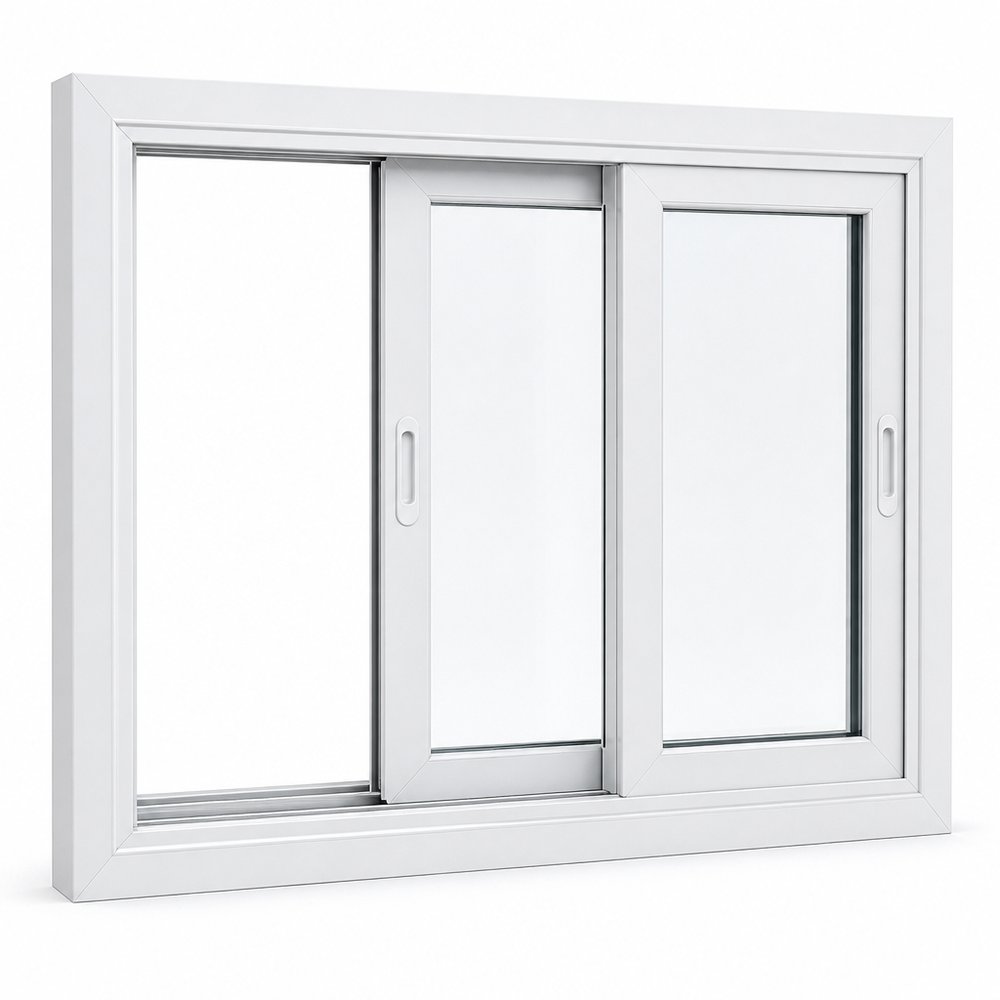
Planning a Commercial or Villa Project?
Send your window schedules or architectural CAD drawings to the OPPGATE engineering team for a prompt, certified quotation and structural review.
Request an Engineered Quotation