
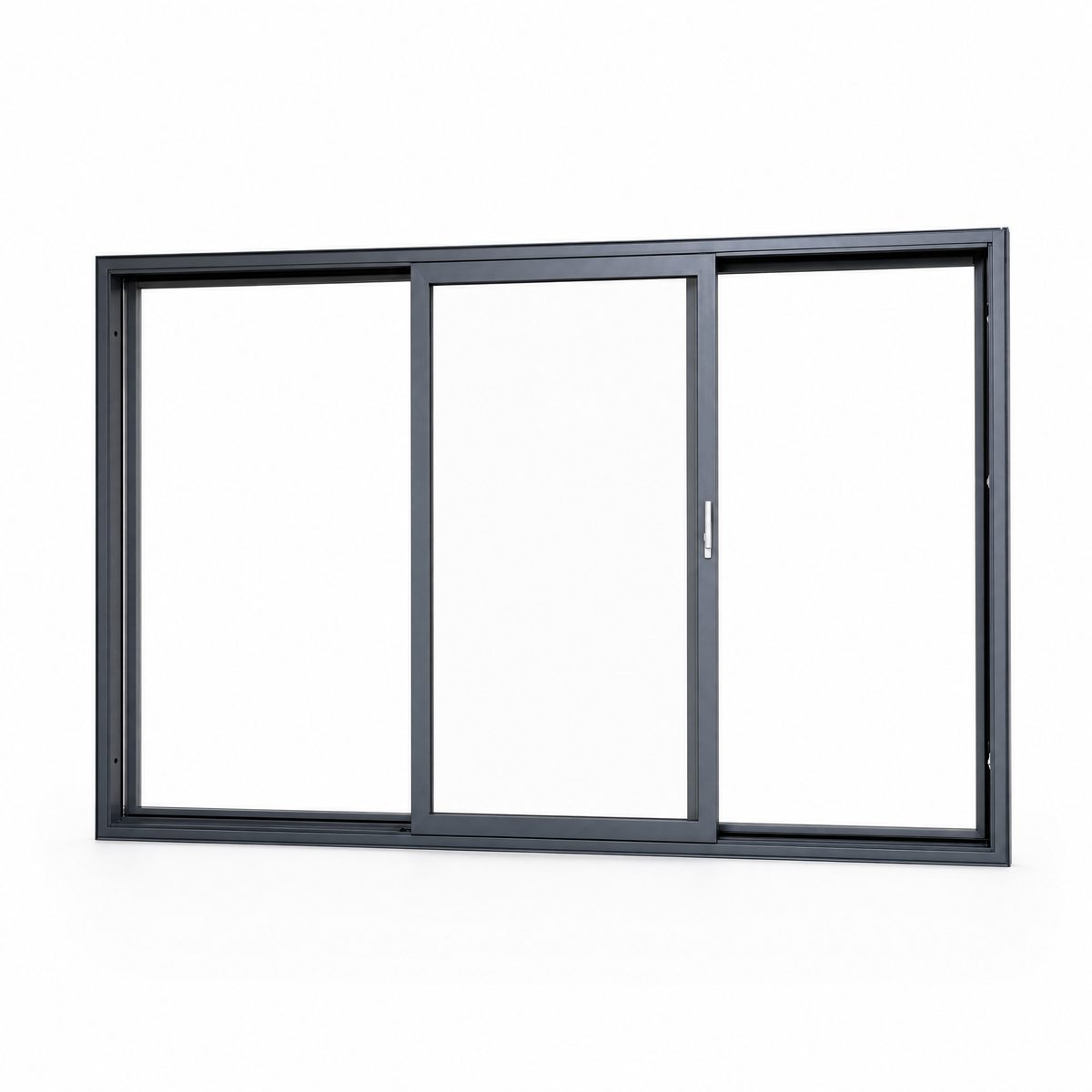
- The gap between two bids is usually scope rather than margin: the base rate hides an assumed glass make-up, hardware family and finish, and the exclusions list carries the rest of the difference.
- A rate per square metre is meaningless until the measured basis is stated, because opening area and glazed area differ by a third or more on a typical casement once frame, sash and bead are deducted.
- Small units carry a higher rate per square metre under any pricing basis, so a schedule dominated by bathroom and stair windows cannot be benchmarked against a schedule of large fixed lights.
- Extrusion is bought by mass, glass by area and hardware by leaf, which is why the three move independently and why a rate build-up for the three largest unit types is worth more than a discount on the total.
- Tooling, mould amortisation, minimum order quantities, non-standard colour batches and sample units are fixed or step costs; a supplier who absorbs them in the rate is not cheaper, only less transparent about when they reappear.
- Under CIF the seller's insurance obligation is minimum cover, commonly Institute Cargo Clauses C, and the risk point is the port of shipment rather than the destination, so a delivered-price comparison can hide both cost and exposure.
- Post-award clauses decide the final number: aluminium escalation against an index with a base date and a cap, currency, quantity tolerance, pre-agreed variation rates and the period for which hardware spares remain available.
1. Why Two Quotations for the Same Window Rarely Match
A quotation for a window looks like a price and behaves like a scope document. Two suppliers asked to price the same schedule can return totals that differ by forty or fifty percent without either of them being dishonest, because the two totals are rarely describing the same product. One assumes a 6 mm float pane in a 60 mm profile with a standard handle; the other assumes a soft-coat low-emissivity double glazed unit in a 70 mm thermally broken system with a multi-point lock. Both are legitimate windows for a commercial building. They are not the same window, and the figure at the foot of the page does not say so anywhere.
The habitual response is to treat the difference as margin and negotiate. That is the wrong lever, and it usually produces the wrong result. A supplier asked to close a forty percent gap on a fully specified scope has three ways to do it: reduce the glass specification, substitute a lighter profile series, or accept the order and recover through variations. Each of the three delivers a building that meets the drawing on paper and the budget in fact, and the shortfall lands on the party who signed the comparison sheet.
Three mechanisms account for most of the spread. The first is the measured basis, because the same window priced on opening area and on glazed area produces two different rates per square metre, and a mixed schedule ranks suppliers differently depending on which basis each one used. The second is the grade assumed inside the base rate, which is where an unqualified rate hides its assumptions about glass, hardware, gasket quality and finish. The third is what sits outside the rate and is priced later as a variation: packing, tooling, spares, non-standard colour, engineering time, and the freight basis on which the goods are delivered.
None of this is exotic to a procurement team. The practical difficulty is that fenestration quotations arrive in a dozen formats, half of them unlabelled, and the schedule itself is often a spreadsheet of widths and heights with no statement of what a rate includes. The remedy is not to read the total more carefully. It is to rebuild every quotation into a normalised schedule before any totals are compared, and to make the scope explicit enough that a low number has to be defended item by item rather than accepted as evidence of efficiency.
2. The Unit Basis: Opening Area, Glazed Area and the Frame Deduction
Fenestration has a standard vocabulary for dimensions, set out in EN 12519, which distinguishes overall dimensions, frame dimensions, daylight opening and clear opening. A rate can legitimately be based on any of them, and a quotation that does not name the one it used cannot be benchmarked against a quotation that used a different one. This is the single most common cause of a comparison that looks decisive and is in fact arbitrary.
Opening-area pricing multiplies overall width by overall height: a 900 mm by 1200 mm casement is 1.08 square metres of opening. Glazed-area pricing measures only the visible glass. On the same unit, deducting a frame face in the region of 60 mm and a sash section in the region of 45 mm leaves roughly 690 mm by 990 mm of glass, or about 0.68 square metres. The ratio between the two figures, around 1.6 in this example, is the ratio between the two rates. A supplier quoting 190 per square metre of glass and a supplier quoting 120 per square metre of opening may be describing the same window at the same total, and the buyer who ranks them on the rate has learned nothing.
The deduction is not a constant. It scales with the perimeter, not the area, so it bites hardest on small units. A 600 mm by 600 mm window has 0.36 square metres of opening and perhaps 0.13 square metres of glass once a wide frame and sash are deducted, a ratio above 2.5. A 2400 mm by 1200 mm fixed light with a narrow sightline can approach 0.9. This is why a schedule of bathroom, stair and service windows carries a materially higher rate per square metre under any basis, and why a benchmark taken from a previous project with a different size mix is not a benchmark at all. It is also why a supplier's published rate for large glazing should never be used to test a schedule of small casements.
Three further conventions belong in writing before the numbers are compared. Minimum charges per unit protect the fabricator on very small sizes and are normal, but they have to be visible rather than buried in an average. Rounding rules matter when a schedule runs to hundreds of units and the measured area is rounded up per line. And the extent of the supply has to be stated: whether sills, reveal liners, louvres, insect screens, restrictors and ironmongery are inside the rate, whether the basis is supply only or supply and install, and whether tax and duty are included or excluded under the stated delivery term. A quotation that answers all of that is worth more to a project than one that is ten percent cheaper and silent on half of it.
The practical instruction to send with the enquiry is short: state the measured basis, state the measured area used against every line of the schedule, and state every exclusion. A supplier who cannot produce that within a day is telling the buyer something useful about the documentation that will follow the order.
3. Where the Cost Actually Sits: Extrusion, Glass and Hardware
The cost structure of a window is not proportional to its area, and the parts of it that dominate change with the size of the unit. Understanding the three main materials separately is what allows a buyer to see which lever a supplier pulled when a total came in low.
Aluminium extrusion is bought by mass. Systems suppliers publish the profile consumption of their series as a figure in kilograms per square metre of finished window, and that figure rises with system depth, with the number of opening leaves and with the number of intermediate mullions, because every additional leaf and every mullion adds another run of perimeter profile that earns no glazed area in return. As an illustration only, a system consuming nine kilograms per square metre of window at an extrusion price of EUR 3.30 per kilogram puts roughly EUR 30 into the frame of each square metre before coating, thermal barrier insertion, cutting, machining and assembly. A 70 mm system does not weigh the same as a 60 mm system for the same elevation, and a two-leaf casement consumes more profile than a fixed light of the same overall size. None of that difference appears in a rate quoted per square metre unless the system is named.
Surface finish is charged in its own right, most often on the basis of coated area rather than window area, because the coated area includes the returns and the full perimeter of every section. Standard white or a narrow range of stock colours is priced as part of the base rate; a specific RAL, a dual-colour finish, a woodgrain lamination or an architectural anodized finish moves to a different line with a different minimum batch. On an anodized project the billet quality requirement also rises, as discussed in the guide to extrusion quality, and that is a cost the buyer pays for whether or not it was requested explicitly.
Glass is priced by area and by make-up, and on commercial elevations it is frequently the largest single material block. Its share grows with the size of the unit and with the number of functional layers: a laminated low-emissivity double glazed unit carries coating, interlayer, gas fill and spacer cost that a monolithic pane does not, and the per-square-metre difference is not linear in any of them. On a 2400 mm by 1200 mm fixed light the glass can reasonably be more than half the material value; on a 600 mm by 900 mm casement the frame and hardware dominate and glass is a minority line.
Hardware is conventionally priced per leaf rather than per window, which is the only basis that reflects the work involved. A multi-point lock with keeps, a friction stay or hinge set rated for the leaf mass, a handle, a restrictor and a night vent are each per-leaf items, and a difference of a few euro per leaf multiplies quickly on a schedule with several hundred leaves. It also explains why a wide single-leaf door and a narrow one can carry similar hardware cost while differing substantially in glass and profile: the leaf count is what the hardware schedule counts.
Labour, overhead and margin behave differently again. Cutting, machining, welding or crimping, glazing and packing are largely fixed per unit, so the per-unit price falls as the order volume rises and the rate per square metre of a repeat order is legitimately lower than that of a one-off. That is a real effect, but it should appear as a visible rate step at a stated quantity break, not as an unexplained discount granted after a negotiation. A buyer who asks for the rate build-up on the three largest unit types in the schedule will usually find that the three or four numbers which matter can be checked in an afternoon, and that the rest of the quotation can then be read with a calibrated eye.
4. The Line Items That Are Never Priced Per Square Metre
Every fenestration order carries costs that have nothing to do with area, and they are the part of a quotation most often left out of the first number and produced in the first variation. They fall into four groups.
The first is tooling. A uPVC system requires an extrusion die and a set of moulds for each profile and each size of welded frame; an aluminium system requires dies for any new section. On a standard system the tooling already exists and the cost is amortised across all customers. On a bespoke section, a special colour family or a non-standard profile it does not, and the supplier has to recover it either as a one-off charge or in the unit rate. The commercial questions are therefore who owns the tool, whether the charge is amortised or one-off, at what volume it is credited back, and what happens on a repeat order two years later. Tooling that is silently absorbed into a rate is not free; it is a rate that will not survive a second negotiation.
The second is minimum order quantity and set-up. Powder coating runs in batches, anodizing in stills, and a specific colour has a minimum chargeable batch even when the order is smaller. A project that wants a particular grey on forty units may be paying for a coating batch sized for several hundred. The same arithmetic applies to special gaskets, custom hardware finishes and branded packing.
The third is one-off units and evidence. Sample windows, mock-up units and test specimens are real products that consume the same production capacity as saleable units, and they are frequently provided free as a gesture and then found, later, to have been priced into the rate for everything else. Certification and third-party testing costs are sometimes passed through on first orders; a test report is evidence about a tested assembly, and paying a fee does not by itself buy performance, so the buyer should ask what was tested and against which standard rather than what it cost. Pre-shipment inspection fees, witnessed testing and the attendance time of a third-party inspector belong in the comparison too.
The fourth is engineering and documentation. Shop drawing production, structural calculations, thermal calculations and the revision cycle round them are engineering hours, and most fabricators include a defined allowance and charge beyond it. A project with a slow approval loop and a design team that issues three rounds of comments will consume that allowance, and the charge appears as a variation that nobody forecast. The count of included revisions should be written down, together with the hourly or per-drawing rate that applies afterwards. Spares belong in this group as well: a stated percentage of glass and hardware held against transit breakage, with a defined mechanism for drawing on it, is worth more than a verbal promise of support, and its cost should be visible on the quotation rather than discovered at the first claim.
5. Glass Make-Up: A Price Variable and a Performance Variable at Once
No single line in a fenestration quotation carries more hidden assumption than the glass. A base rate almost always assumes a default double glazed unit, and every property the specification actually requires - solar control, thermal performance, acoustic attenuation, safety, security, wind-borne debris resistance - is delivered by changing that default. Because the change is a variation, its price is negotiated at the worst possible moment, after the order is placed and the programme is running.
The make-up should therefore be written out in full and priced as a matrix: glass thicknesses, cavity width, coating type and its position in the assembly, gas fill, spacer type, interlayer type and thickness, edge work and any heat treatment. Each element is both a cost and a performance lever. A soft-coat low-emissivity coating on the appropriate surface reduces long-wave heat loss far more effectively than a hard coat, but it must be protected inside the cavity and it constrains handling. Argon raises the insulation of the cavity modestly for a small cost; krypton performs better in narrow cavities and costs considerably more. A warm-edge spacer reduces the linear thermal bridge at the glass edge and is worth more on a thermally efficient frame than on a poor one.
Safety glass follows its own product standards, and the buyer should reference them rather than a trade adjective. Thermally toughened soda lime silicate safety glass is covered by the EN 12150 series, laminated glass and laminated safety glass by the EN ISO 12543 series, and insulating glass units by the EN 1279 series. The choice between fully toughened and heat-strengthened glass changes the breakage pattern and the cost, and in overhead or sloped glazing it is a design decision with a life-safety consequence rather than a purchasing preference. Where an interlayer is specified, the difference between a conventional polyvinyl butyral interlayer and a stiffer structural interlayer is felt in post-break retention, in the stiffness of the assembly and in the price; a project that needs the first two should not be buying on the third.
Triple glazing deserves separate treatment because its cost does not stop at the glass. The additional pane adds mass, which loads hinges, friction stays and operators; it usually requires a deeper frame, which changes the profile consumption and the wall interface; and it adds freight volume and weight to every container. A glazing upgrade priced only as an extra cost per square metre of glass will understate its effect on the rest of the order. Conversely, a specification that fixes an ambitious whole-window U-value while leaving the frame and spacer unspecified has fixed the smallest part of the calculation: EN ISO 10077-1 combines centre-of-glass, frame and spacer performance into the window figure, and a good unit in a poor frame will not deliver the number. The productive request is not a performance claim but the input values behind it.
6. Packing, Volume and the Incoterm That Decides the Risk
On exported fenestration, packing is a cost line in its own right and a variable that changes the freight result, which is why two quotations for identical units can arrive with different container counts. A crate for framed units and a steel A-frame for large glass or glazed panels protect against different failure modes; corner protection, foam interleaving, stretch wrapping, desiccant and strapping all add cost and all change the external dimensions. The packing method should be stated in the quotation, not inferred from a photograph, because a supplier who packs in a way that consumes twenty percent more volume per unit is not cheaper when the freight is added, even at an identical unit rate.
Freight is charged on whichever is greater, volume or weight, and the two behave differently for this product. Glass is heavy: a laminated double glazed unit carries roughly twenty-five kilograms per square metre for every ten millimetres of glass thickness, so a dense load of large units can reach a container's payload limit before its volume is used. A load of small frames does the opposite and cubes out early. A 40 ft high-cube container offers something in the region of sixty-five to sixty-eight cubic metres of practical loading once crates, dunnage and clearance are accounted for, and the payload available on a given trade lane is a routing question rather than a constant. Units longer than about six metres, and door leaves or panels that exceed normal handling envelopes, move into a different packing and handling category altogether, and that cost belongs in the comparison from the start.
The delivery term decides who pays for which part of that and, more importantly, where risk passes. Under Incoterms 2020 rules published by the International Chamber of Commerce, the common options read very differently for a fenestration order. Ex works leaves everything with the buyer from the factory gate. Free on board places the goods on board the vessel at the named port with export clearance handled by the seller, and risk passes at that point. Cost, insurance and freight has the seller pay freight and insurance to the destination port, but the insurance obligation is only minimum cover, conventionally Institute Cargo Clauses C, and the risk point remains the port of shipment rather than the destination. Delivered at place has the seller deliver to a named place, usually the site, with import clearance and duty remaining with the buyer. Delivered duty paid moves clearance and duty to the seller, which sounds convenient and can be awkward where the seller cannot act as importer of record in the destination country.
The practical consequence is that a delivered price is only comparable with another delivered price if both use the same term, the same named place and the same packing method, and if the insurance cover behind it is stated. Many procurement teams find that free on board with their own forwarder gives them both a lower landed cost and far better visibility of the shipment; others prefer delivered at place where site coordination and a single point of responsibility matter more than the last few percent. Either can be right. What is not right is comparing a free-on-board figure with a delivered-duty-paid figure and concluding that one supplier is expensive.
7. The Clauses That Move the Price After the Order Is Placed
The awarded number is not the final number. On a fenestration order of any size, four clauses determine how far the two diverge, and all four are cheaper to negotiate before signature than after.
The first is the price basis for aluminium. Extrusion is a metal-priced product, and suppliers commonly tie a quotation to a reference price for primary aluminium on a stated date, with an escalation formula that adjusts the unit rate if the market moves. That mechanism is fair in principle and dangerous in practice when it has no base date, no named index and no cap. A workable clause names the index, fixes the base value and the date it was taken, defines the de minimis band inside which no adjustment is made, and sets a ceiling beyond which the supplier absorbs the movement. The same discipline applies to glass, where energy-intensive production has its own cost volatility, and to the currency of the contract where the supplier's costs are incurred in a different one.
The second is quantity tolerance. Site-measured schedules rarely match the tender schedule exactly, and a clause allowing plus or minus five or ten percent at the contract rate protects both parties from renegotiating at the point of maximum pressure. It should be paired with a variation rate table agreed at award, giving per-square-metre and per-unit prices for added types and for changed specifications, so that an instruction issued on site has a known price rather than a quotation cycle attached to it.
The third is time. Lead time should be defined from the two events that actually start production, namely the deposit and the approval of shop drawings, because a lead time counted from the purchase order is a promise the factory cannot keep while it waits for approvals. Expediting, storage at the port, demurrage and re-delivery all have charges attached, and they should be listed rather than discovered. Payment structure belongs here too: a deposit with the balance against documents is not equivalent in cost to a documentary credit under UCP 600, because the credit carries bank charges and often a margin requirement, and that cost belongs in the total comparison even though it never appears on the supplier's quotation.
The fourth is warranty, which is easiest to compare in the wrong direction. What matters is the duration by component, what is actually covered, who pays the return freight, and what is excluded. Sealed unit durability is normally discussed against the EN 1279 series, hardware against its own cycle rating, and the finish against a corrosion classification rather than a promise. Breakage, salt exposure on coastal sites, installation by others, modified units and unauthorised re-glazing are standard exclusions and are reasonable; the point is to know they exist before a claim. A further question worth asking in writing is the period for which spare hardware, gaskets and glazing beads for that system will remain available, because a window with a fifteen-year warranty and no replacement handle in year eight is a maintenance liability rather than an asset.
8. A Normalisation Sheet and the Questions Worth Sending Back
The method that resolves all of this is unglamorous: fix the schedule, fix the make-up, fix the basis, then compare. In practice that means building one normalisation sheet from every quotation received, with the same fields in the same order, and refusing to look at a total until the sheet is complete. The table sets out the fields that decide the comparison and the reason each one matters.
| Field to normalise | What to require in writing | Why it decides the comparison |
|---|---|---|
| Measured basis | Opening area, glazed area or frame dimension, with the area used against each schedule line | Two rates per square metre on different bases cannot be ranked |
| System and profile | Series name, depth, alloy and temper, wall thickness, thermal barrier construction | Profile mass and stiffness explain much of the rate difference |
| Glass make-up | Full build-up: thicknesses, cavity, coating and position, gas, spacer, interlayer, edge work | The default assumed by a base rate is where the hidden cost sits |
| Hardware schedule | Per-leaf items named, with lock, hinge or stay class and handle finish | Hardware is priced per leaf, not per square metre |
| Finish and colour | Coating type, colour reference, and whether it is stock or a special batch | Special colour carries a minimum batch charge |
| Tooling and MOQ | One-off or amortised, ownership, credit-back volume, repeat-order treatment | Fixed costs reappear somewhere if they are not stated |
| Packing | Method, protection, units per crate, external dimensions | Packing volume changes the container count and the freight |
| Delivery term | Incoterm, named place, packing included, insurance cover stated | Cost and risk transfer sit in different places under each rule |
| Variation rates | Prices per square metre and per unit for added types and changed specification | Prevents renegotiation at the moment of maximum pressure |
| Warranty | Duration by component, exclusions, claim process, spare availability period | Determines the cost of ownership after handover |
Six questions are worth sending to every bidder before the sheet is closed. Which measured basis and which area apply to each line. What the rate build-up is for the three largest unit types in the schedule. What is excluded from the rate, without exception. What the complete glass make-up is, element by element. What the price is for a ten percent increase or decrease in quantity and for an added unit type. And what the position is on tooling, sample units and spare hardware for a repeat order. A supplier who answers all six in writing is telling the buyer that the documentation, the shop drawings and the eventual claim process will be conducted the same way.
The last point is a matter of discipline rather than engineering. Award on the normalised number, and keep the sheet as the record of what was actually bought. The headline total is a marketing artefact; the normalised schedule is the contract.
Explore OPPGATE Aluminum Windows
Thermal break aluminum sliding, casement, tilt-and-turn and panoramic window systems for global residential and commercial projects.
View All Aluminum Windows Models
Planning a Commercial or Villa Project?
Send your window schedules or architectural CAD drawings to the OPPGATE engineering team for a prompt, certified quotation and structural review.
Request an Engineered Quotation