
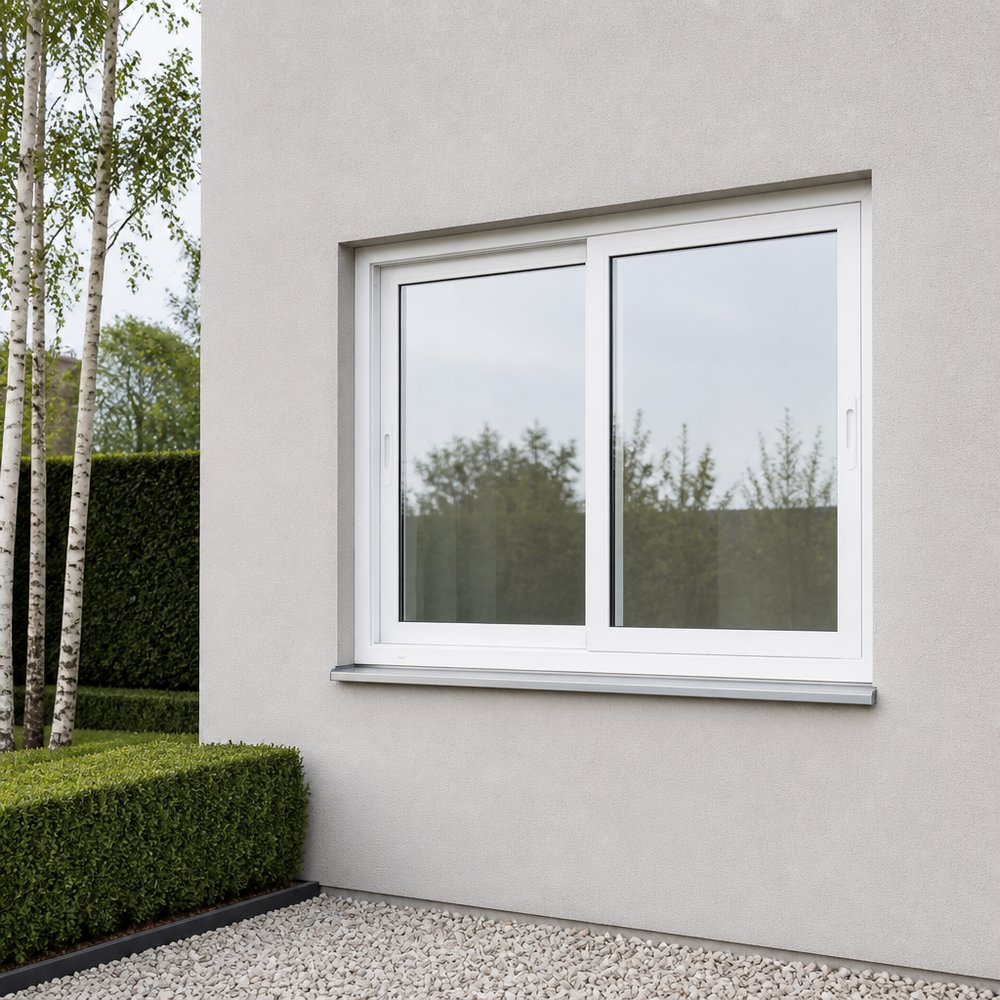
- In a casement the hardware compresses the gasket; in a horizontal slider nothing compresses anything. The seal is an interference fit set in the factory, and it can only get worse on site.
- Leakage through the perimeter of a slider behaves like flow through a long slot, where the rate rises steeply as the gap grows - so a seal that has worn by a fraction of a millimetre loses far more than a fraction of its performance.
- The interlock is a water crossing as well as a structural joint: water landing on the inner track has to be carried under or through the meeting stiles to the outer track before it can leave the frame.
- The tolerance stack at the overlap - frame squareness, sash squareness, track position, roller height and profile straightness - must add up to less than the overlap depth, or the two sashes meet metal to metal and the seal line opens.
- Roller load and track flatness decide the head gap. A sash that settles a couple of millimetres at the leading edge opens the top seal along its whole length, and no adjustment of the brush will close it again.
- A slider's clear opening is roughly half the frame width, its acoustic rating is limited by a linear leak at the interlock rather than by the glass, and its airtightness depends on installation squareness in a way that a compression-sealed window does not.
1. A Sliding Window Is Not a Casement With the Hinge Removed
The casement and the slider are usually drawn next to each other in the same schedule, priced from the same profile system and tested to the same product standard, which makes it easy to assume they behave the same way. They do not. A casement closes by being pulled onto a gasket. The handle drives an espagnolette or a multi-point lock, the cams engage keeps on the frame, and the sash travels a few millimetres towards the frame until the gasket is compressed by an amount the hardware and the gasket geometry were designed to produce. The closing force is mechanical, repeatable and independent of the operator. That is why a casement can be sealed to a high class with a modest gasket and why the seal still works on the day the building is handed over.
A horizontal slider has none of that. Both sashes stay in their own plane, the moving leaf travels past the fixed one, and the only closing force is the hand that pushed it. There is no cam, no compression and no travel at the end of the stroke. Whatever sealing exists was set at the factory as an interference between a brush or a fin and the face it runs against, and the handle's only jobs are security and, on some systems, a light pull-together at the meeting stiles. Everything that follows in this guide comes from that one difference.
It produces six consequences that a specifier should hold in mind at once. The leakage path is linear rather than a compression line: it runs along the head, the sill, both jambs and the full height of the interlock, so the leak is distributed and hard to see. Performance is size-dependent, because the perimeter grows more slowly than the area but the seal line grows with every extra millimetre of sash. Drainage becomes two-stage, because water can land on an inner track that has no direct route to the outside. Security depends on anti-lift hardware rather than on hinge side geometry, since a closed slider can be lifted unless something stops it. The clear opening is roughly half the frame width. And there is no adjustment screw that makes the window tighter - only one that makes it slide better or worse.
None of that makes the slider the weaker product. In large openings, in corridors, on balconies and anywhere a swinging sash would be a hazard, it is the correct answer, and a well-detailed slider will outperform a poorly detailed casement. It does mean the specification has to ask different questions, and the first of them is about the seal itself.
2. The Seal Is a Wiping Contact, Not a Compressed Gasket
Three sealing elements do the work on a horizontal slider. The first is brush pile: a strip of polypropylene or polyamide filament held in a carrier and set into a groove in the sash or frame, bearing against the adjacent face. The second is a fin or wiper, usually an EPDM or thermoplastic elastomer lip that runs against the track or the frame face. The third is the central overlap seal at the interlock, which is often a combination of both. On better systems the head and jambs carry a brush plus a fin, and the two are expected to fail in different ways so that the assembly degrades gradually rather than all at once.
The engineering point is that none of these elements generates pressure. A brush seal works by having enough filament density and enough interference that the filaments bend against the surface and close the gap statistically rather than perfectly. A fin works by being deflected, which stores a small restoring force. Both are sensitive to the size of the gap they are asked to close, and both are sensitive to what the gap does over time. Filaments take a permanent set under sustained deflection. Grit and sand abrade the tips. UV and heat age the elastomer. The rollers wear and the sash drops a fraction of a millimetre, and the gap that the seal was sized for is no longer the gap it sees.
That last point is why the deterioration is not linear. Flow through a narrow long slot - which is a fair description of the gap under a worn brush along a head profile - rises roughly with the cube of the gap height for a given pressure difference, and only linearly with the length of the slot. Halving the gap does not halve the leakage; it reduces it by something closer to a factor of eight. The same relationship runs the other way, which is why a seal that has opened by a fraction of a millimetre can turn a good test result into a complaint about draughts two winters later, and why the visible dust line on a brush is not a reliable indicator of how much air is passing it.
Two practical consequences follow. First, the seal is a consumable and should be specified as one: named material, named filament or lip geometry, and a stated replacement interval with the profile reference, because a brush that cannot be re-ordered in five years turns a serviceable window into a replacement. Second, the seal cannot compensate for a bad tolerance. Manufacturers who widen the brush to cover a sloppy interlock are moving the failure from the factory to the third year of service.
3. The Interlock: Geometry, Tolerance Stack and the Line That Has to Stay Closed
The interlock is the detail that separates a sliding window from every other type, and it is where most of the engineering effort in a good system sits. In a two-track residential or light commercial slider, the meeting stiles of the two sashes overlap and hook into one another: one stile carries a projecting hook or a pair of ribs, the other carries a matching recess plus the seal. In the closed position the two are engaged, and the engagement is what stops wind pressure from separating them and what stops a thin blade from being inserted between them. The depth of that engagement - the overlap - is the single most important dimension in the whole assembly after the glass.
It is also the dimension most exposed to accumulation. The overlap has to absorb the sum of several independent errors: the squareness of the outer frame, which is set by how the frame was assembled and how it was fixed into the opening; the squareness of each sash; the position of the tracks relative to one another; the height setting of the rollers; and the straightness of the profiles themselves over the length of the unit. Each of those is individually small and individually acceptable. Their sum is what the overlap has to be larger than, and on a tall unit the sum is not small.
When the stack exceeds the overlap, the failure is quiet. The sashes close, the lock engages, and the window looks correct. What has happened is that the seal at the interlock has been squeezed to zero and the two stiles are bearing metal on metal, so the seal line is open along part of its height, usually at the top on one sash and the bottom on the other. The occupant reports a draught at head height in one room and nothing anywhere else. Nothing in the frame looks wrong, which is why this failure is so often attributed to the seal material rather than to geometry.
Track count belongs in the same discussion. A two-track frame puts the two sashes in adjacent planes and gives the deepest possible overlap for a given frame depth. Adding a third track for an insect screen is convenient and common, but it consumes frame depth that would otherwise have gone into the sashes, so either the profiles narrow or the frame deepens. It is worth checking which of the two happened, because a third track bought at the cost of a shallower interlock is a drainage and airtightness decision disguised as an accessory.
Structurally, the interlock is where the two sashes act together. Engaged, the pair behaves more like a coupled beam than two independent leaves, and the wind load on the larger sash is partly transferred through the meeting stiles. That is only true while the engagement is maintained under load, which is a function of hook geometry and of the anti-lift blocks that stop the moving sash rising out of its track. Where the anti-lift detail is omitted or defeated to make the sash easier to lift out for cleaning, both the security and the structural assumption go with it.
4. Drainage: The Bypass Principle and Why Weep Holes Get Blocked
Water management in a slider is a routing problem, and the routing has two levels. Water that lands on the outer track - the one nearest the weather - can leave the frame directly through weepholes or slots in the outer face, and a well-made frame slopes its track towards those outlets so that the water does not have to stand. Water that lands on the inner track has no direct route out. It must travel laterally along the track to the interlock, cross from the inner plane to the outer plane there, and then join the outer track on its way to the weepholes. That crossing is the detail the whole window depends on, and it is normally a small weir or a shaped slot under the meeting stiles rather than a hole through the frame.
Why not simply put a hole in the inner track and let it drain straight out? Because a hole in the inner track is a hole in the barrier. Under wind-driven rain the outer face is pressurised, the cavity behind it is partly pressurised, and any opening that connects the inside face to the weather is a path for water driven by that pressure difference. The bypass is a compromise: it takes water the long way round, through a restricted section, so that the pressure drop across the weather seal is maintained while the water still has somewhere to go. Getting the sizes wrong in either direction has a cost - too generous and it leaks air and water inward, too tight and it silts up.
Silting is the common failure, and it is worth knowing what blocks a drainage path on a real building. Mortar droppings from the render or the cill bedding. Sealant applied by an installer who has been told to seal the window to the wall and has taken that instruction to include the weepholes. Insect nests and pollen in warm climates. Ice in cold ones. And on the inner track, dust carried in by the very air leakage the seal is supposed to prevent, which mixes with condensation and forms a paste that sets in the weir. The symptom is water appearing on the internal sill after a storm, and the diagnosis is usually made by looking at the outside of the frame rather than the inside.
Two installation details decide whether the designed path survives. The first is the sill: a projecting sill with a drip below its front edge is what stops water tracking back under the frame, and a sill set flat or falling backwards defeats every weephole in the window. The second is the sealant line. Sealing the frame to the wall along the full sill is correct practice; sealing across the drainage path is not, and on many sites the two look identical until it rains. A shop drawing that marks the drainage outlets with the note - do not seal - is worth more than a paragraph of specification text, because the person applying the sealant works from the drawing.
One further point is worth stating because it explains a great many test-versus-site discrepancies. A laboratory water test is normally run on a specimen in a chamber, with a defined sill or no sill at all, and with the drainage open exactly as the designer intended. The same window installed into a recessed opening with a shallow reveal, a blocked weir and a decorative surround that collects water is a different hydraulic system. The test result describes the product. It does not describe the junction.
5. Rollers, Track Flatness and the Sag That Opens the Seal
A sliding sash hangs on rollers, and the rollers are the only part of the window that carries load continuously. The arithmetic is worth doing on a representative unit, because it is usually larger than buyers expect. Glass weighs about 2.5 kilograms per square metre per millimetre of thickness, so a double-glazed unit with two 4 mm panes carries roughly 20 kilograms per square metre of glazed area. A 1.5 m by 1.2 m sliding sash has 1.8 square metres of area, so its glazing alone is around 36 kilograms. Add the profile, the reinforcement inside it and the hardware and the leaf is comfortably in the region of 45 to 50 kilograms. On two rollers that is over 20 kilograms per wheel before any wind or operating load; on a wider leaf it is more.
What matters is not the static load but what the load does to the gap. A loaded roller compresses its tyre, a long track deflects between its fixings, and a sash that is supported at two points near its ends will sag slightly in the middle of its bottom rail. All three effects add at the leading edge, which is exactly where the brush at the head has the least interference. The visible result is a sash that has dropped a millimetre or two at the closing stile, a head gap that opens along the top rail, and a sill seal that is now being run over rather than against. Tandem rollers, a larger wheel diameter, a hardened track and a track that is continuously supported rather than fixed at intervals all attack the same problem from different directions.
Track flatness is the other half. On a wide opening the track is a long thin member fixed into a frame that is itself fixed into a structural opening, and any deviation - a joint that steps, a fixing that pulls the track down, a reveal that is not straight - becomes a local ramp. The sash rises over it and drops after it, and the seal is asked to follow. It cannot. Adjustable rollers let the installer compensate for a constant offset, which is what they are for, but they cannot compensate for a step, and using them to lift a sash to close a head gap usually produces a sash that binds in the middle of its travel and a customer who reports that the window is stiff.
There is a commercial point buried here. Roller quality is invisible in a quotation: two suppliers quoting the same profile system can differ by a factor in the specification of the wheel, the bearing and the track. The difference shows up as operable force at handover and as head gap in year five. Asking for the roller type, the number per sash, the rated load and the track material is a cheap question with an expensive answer if it is not asked.
6. Site Tolerance: Why a Square Window Fails in an Out-of-Square Opening
Every window is a rigid box being fitted into an opening that was built by other trades to a different tolerance. For a casement the frame can absorb a surprising amount of that mismatch, because the sash is pulled onto a gasket by hardware and the gasket has some capacity to follow a distorted frame. A slider has much less room. Its two tracks have to remain coplanar and parallel over their full length, because the sash runs on both of them at once and the seal runs along both of them at once. Twist the frame and the tracks are no longer parallel. The sash then either binds or, if the rollers are adjusted to free it, sits at an angle and opens the seal at one end of its travel.
The installation sequence that produces a working slider is not complicated, but each step is easy to skip. The frame is set on packers under the track, not under the jambs alone, so the track is supported where the load is. It is levelled along its length and across its depth. The diagonals are checked, because equal diagonals are the only practical field check on squareness. It is fixed, then the diagonals are checked again, because fixing is where twist is introduced. Only then are the sashes hung, and only then are the rollers adjusted - with the sash in the closed position, so that the gap being set is the gap that matters.
The most common site failure is an adjustment made for the wrong reason. A draught is reported, the rollers are wound up to pull the sash tighter against the head, the sash now rides on the track, the customer reports a stiff window, and the draught returns when the sash settles. The correct response to a head gap is to establish whether it comes from roller height, from track flatness, from sash squareness or from the frame, and to fix that; the roller is a height adjustment, not a seal adjustment.
Two related details are worth writing into the installation method statement. Packing and fixing should not distort the drainage path - a packer placed under a weephole is a blocked weephole. And the junction between frame and opening should be sealed on the correct side of the drainage plane: the outside of the frame is sealed to the wall, the inside is finished with a vapour-tight joint, and the cavity between them is left able to drain. A window that is sealed identically on both faces has a cavity that cannot dry, which in a cold climate becomes a condensation problem and in a warm one becomes a mould problem at the reveal.
None of this is exotic. It is the ordinary discipline of installing a movement-tolerant product into a structure that moves, and it is the part of the performance that the factory cannot deliver by itself.
7. Where the Slider Wins, Where It Loses, and What the Test Certificate Does Not Say
Framed against a compression-sealed window, the horizontal slider trades three performance characteristics for three practical ones, and the trade is worth making explicit in the specification note rather than leaving to preference.
It loses on airtightness, because a wiping seal cannot match a compressed gasket, and because the interlock adds a full-height linear path that a casement does not have. It loses on acoustics for the same reason: the acoustic performance of a glazed unit is set by its weakest element, and on a slider the weakest element is usually the seal line at the meeting stiles rather than the glass, which is why a slider specified with the same laminated or asymmetric build as a casement will not deliver the same rating. And it loses on clear opening: a two-panel slider gives roughly half the frame width as a clear opening, measured full height, which on escape or egress routes is often enough in height and marginal in width.
It wins on space, because no sash swings into the room or across a balcony. It wins on large openings, where a single sliding leaf can be wider than any practical casement and where the wind load on an open projecting sash would otherwise have to be carried by friction stays. And it wins on operation at height and in corridors, where a push-along leaf is safer than a swinging one and where the hardware duty is a track rather than a hinge.
| Criterion | Horizontal slider | Casement or tilt-and-turn |
|---|---|---|
| Seal mechanism | Wiping brush or fin, set at the factory, no closing compression | Gasket compressed by cams or espagnolette at every lock point |
| Sensitivity to installation | High: both tracks must stay coplanar, twist opens the seal | Moderate: gasket compression absorbs some frame distortion |
| Water management | Two-stage: inner track drains through the interlock to the outer track | Single-stage: drained sill below a compression seal |
| Clear opening | About half the frame width, full height | Full sash width and height, less the frame |
| Acoustic limit | Set by the interlock leak rather than the glass build | Set by glass build and gasket condition |
| Security detail | Interlock engagement plus anti-lift blocks | Hinge side plus lock points around the sash |
| Maintenance | Brush and fin replacement, track cleaning, roller adjustment | Gasket replacement, hinge and lock adjustment |
The certificate deserves its own paragraph, because it is routinely over-read. A performance declaration under a product standard - EN 14351-1 in Europe, the NAFS standard in North America, AS 2047 in Australia - reports characteristics measured on a specimen of a stated size and configuration, under stated test methods, with air permeability, watertightness and wind resistance classified according to the relevant classification standards. It does not report the performance of every size in a family, it does not describe the installed junction, and it does not survive a change of seal, interlock geometry or roller without re-assessment. A tender that asks for a class without asking which specimen produced it has asked a question with a comfortable answer and no information in it.
8. Specification and Handover Checklist
The clauses below are the ones that decide whether the delivered slider behaves like the tested one. They are written to be dropped into a specification or used as a clarification list, and each is answerable in writing by a competent fabricator.
- Product standard and specimen. Name the standard, the performance classes required, and the size and configuration of the specimen that produced them. Require confirmation that the specified configuration - sash count, glazing build, seal type, interlock - is covered by that evidence.
- Seal schedule. Brush and fin material, filament or lip type, carrier profile reference, and the replacement part number. State that the seal is a service item and that spares must be available for the life of the installation.
- Interlock overlap. The nominal engagement depth at the meeting stiles, with the allowable tolerance stack, stated on the shop drawing rather than left to the profile.
- Drainage drawing. A section through the sill showing track falls, weephole positions, the weir under the interlock, and the note that outlets must not be sealed or packed. Require the same drawing at handover as installed.
- Rollers and track. Number of rollers per sash, wheel material and diameter, rated load, track material and fixing pitch - and confirmation that the track is continuously supported over its length.
- Anti-lift. The anti-lift block or equivalent detail, and a statement that it cannot be removed without tools.
- Installation tolerance. Maximum permitted twist and out-of-square for the installed frame, the method of checking it, and the requirement that rollers are adjusted with the sash closed.
- Handover inspection. A draught check at the head and at the interlock with the unit closed, a water test on the sill drainage, and an operable-force check on each leaf.
Two questions are worth adding to the tender round because the answers separate fabricators who understand the product from those who resell it. Ask what happens to water that lands on the inner track, and ask for the drawing that shows it. Ask which single dimension in the assembly has to be larger than the sum of the tolerances, and listen for the word overlap.
A horizontal slider is a good window when it is detailed as a slider: a wiping seal treated as a wear item, an interlock treated as both a structural joint and a water crossing, a drainage route that survives a renderer and a sealant gun, and an installation that keeps two tracks parallel. It is a poor window when it is specified as a casement with the swing removed, because then the seal, the drainage and the tolerance stack are all being asked to do something they were never designed to do - and the failure will appear as a draught, a damp patch on an internal sill, or a sash that no longer runs true, long after the certificate has been filed.
Explore OPPGATE uPVC Windows
Multi-chamber uPVC sliding and casement window systems with customized double/single glazing and security hardware.
View All uPVC Windows Models
Planning a Commercial or Villa Project?
Send your window schedules or architectural CAD drawings to the OPPGATE engineering team for a prompt, certified quotation and structural review.
Request an Engineered Quotation